Viscous Free-Surface Flows
PhD Thesis by Vatsal Sanjay
Physics of Fluids Department, University of Twente
Defended: July 2022




PhD defense stream
Defense details
Date & time: Friday 15 July 2022, 12:30 - 13:30
Thesis committee:
- Devaraj van der Meer (chairperson, University of Twente)
- Detlef Lohse (promotor, University of Twente)
- David Quere (ESPCI & LadHyX)
- E. Harald van Brummelen (Eindhoven University of Technology)
- Wilko Rohlfs (University of Twente)
- Marjolein van der Linden (University of Twente)
- Maziyar Jalaal (University of Amsterdam)
Thesis Summary
Motivation: Many modern technologies depend on how liquids behave at their surface, where they meet air. A droplet bouncing off a water-repellent coating, a thin film tearing as a bubble bursts, or a spray droplet landing on a wet layer are familiar examples. These rapid events sit at the heart of precision printing and coating, agricultural spraying, spray-based cooling of high-power equipment, and responses to environmental hazards such as oil contamination.
Challenge: Yet these processes are still difficult to predict and control. Small changes in a liquid's viscosity (how "thick" it is), the properties of the surrounding fluid, or the presence of a pre-existing film can switch an outcome from bouncing to sticking, from gentle spreading to unexpectedly large forces, or from a quiet bubble to the release of fine airborne droplets. Because the key mechanisms happen in milliseconds and at tiny length scales, many current design rules still rely on trial and error.
Focus: This project will build a practical, physics-based understanding of viscous flows at liquid surfaces. We will focus on three connected problems: how droplets hit and rebound from highly repellent surfaces; how droplets behave when they land on a thin liquid film or collide with another droplet, as in printing and drop-by-drop manufacturing; and how thin films and bubbles rupture and retract in thick materials such as pastes and slurries. Together, these studies will show how viscosity and the surrounding fluid set the forces generated, how energy is lost, and whether tiny airborne droplets are produced.
Approach: We will combine high-speed experiments with advanced computer simulations that track the moving liquid-air boundary in detail. By comparing measurements and simulations, we will identify how surface tension (the skin-like force that pulls a surface flat) turns into motion and how that motion is damped by viscous losses in both the liquid and its surroundings. The outcome will be simplified predictive models and practical maps that show which behavior to expect under given operating conditions, and how to adjust material properties or operating conditions to achieve the desired outcome.
Impact: The potential benefits are broad and directly relevant to the United Kingdom's industrial base, from agriculture and manufacturing to energy and environmental protection. Predicting when droplets will stick rather than bounce can improve pesticide deposition on plants, reduce overspray, and make printing, coating and spray-cooling processes more reliable, helping to avoid dry patches and local overheating. Understanding film rupture and bubble bursting can inform how foams, pastes and slurries release droplets at their surface, affecting cleanliness and product quality, and can improve models for how thin liquid layers spread and break up during oil spills.
Outcome: By delivering validated models, open datasets and straightforward design guidance, the project will help engineers replace trial-and-error approaches with predictive tools. The longer-term impact will be safer, cleaner and more efficient technologies wherever liquids meet air.
Thesis Video Summary
Highlights
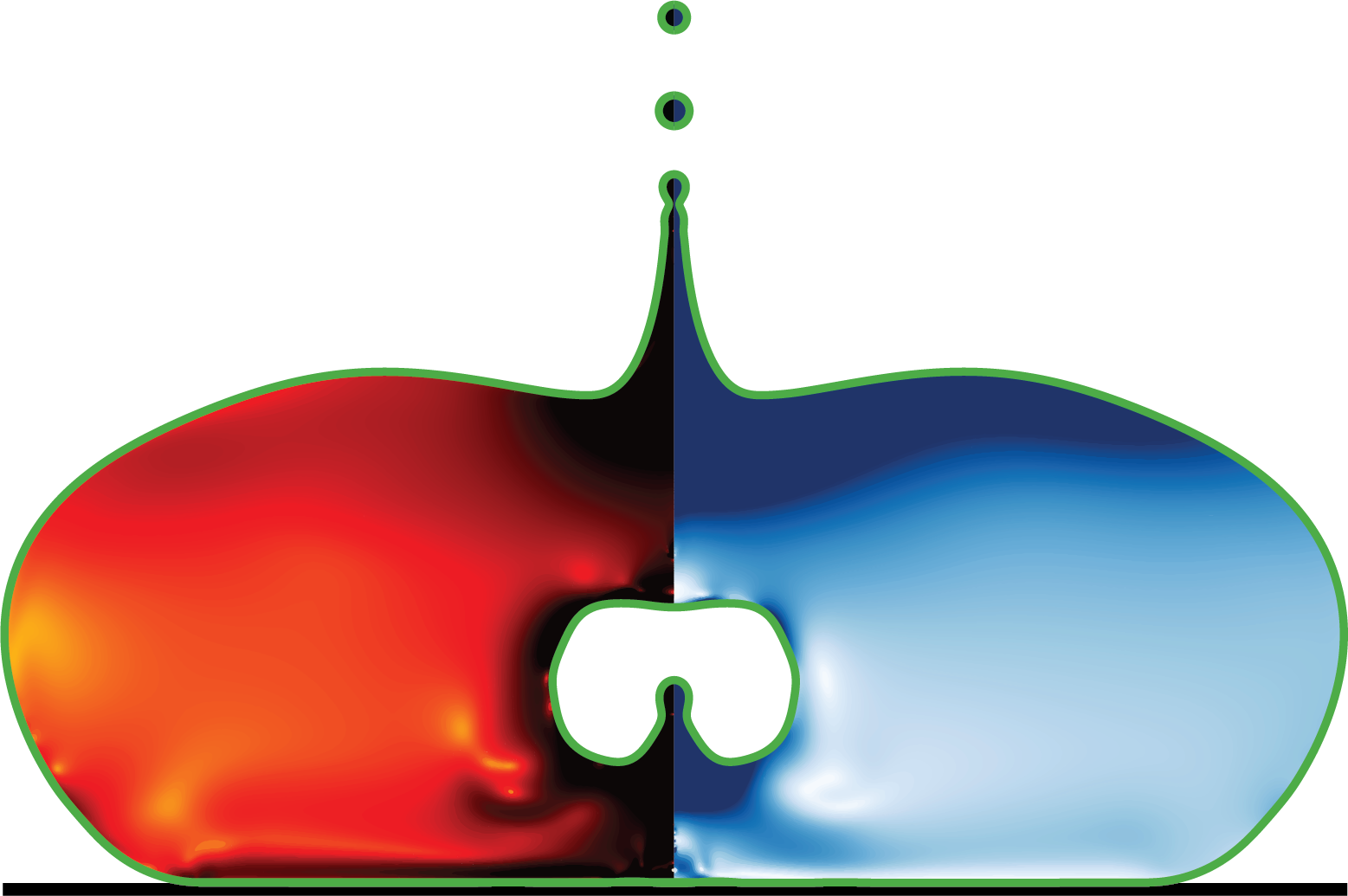
- Impact forces: A second force peak appears during lift-off as a downward jet forms inside the drop.
- Bounce limit: Rebound ends when viscous and gravity effects satisfy \(Oh_{d,c} + Bo_c = 1\) or films become too thick.
- Retraction and bursting: Viscous surroundings and yield-stress media reshape sheet retraction and bubble craters.
This AI-generated recap surveys viscous free-surface flows, focusing on how viscous stresses govern drop impact, rebound, and bubble bursting.