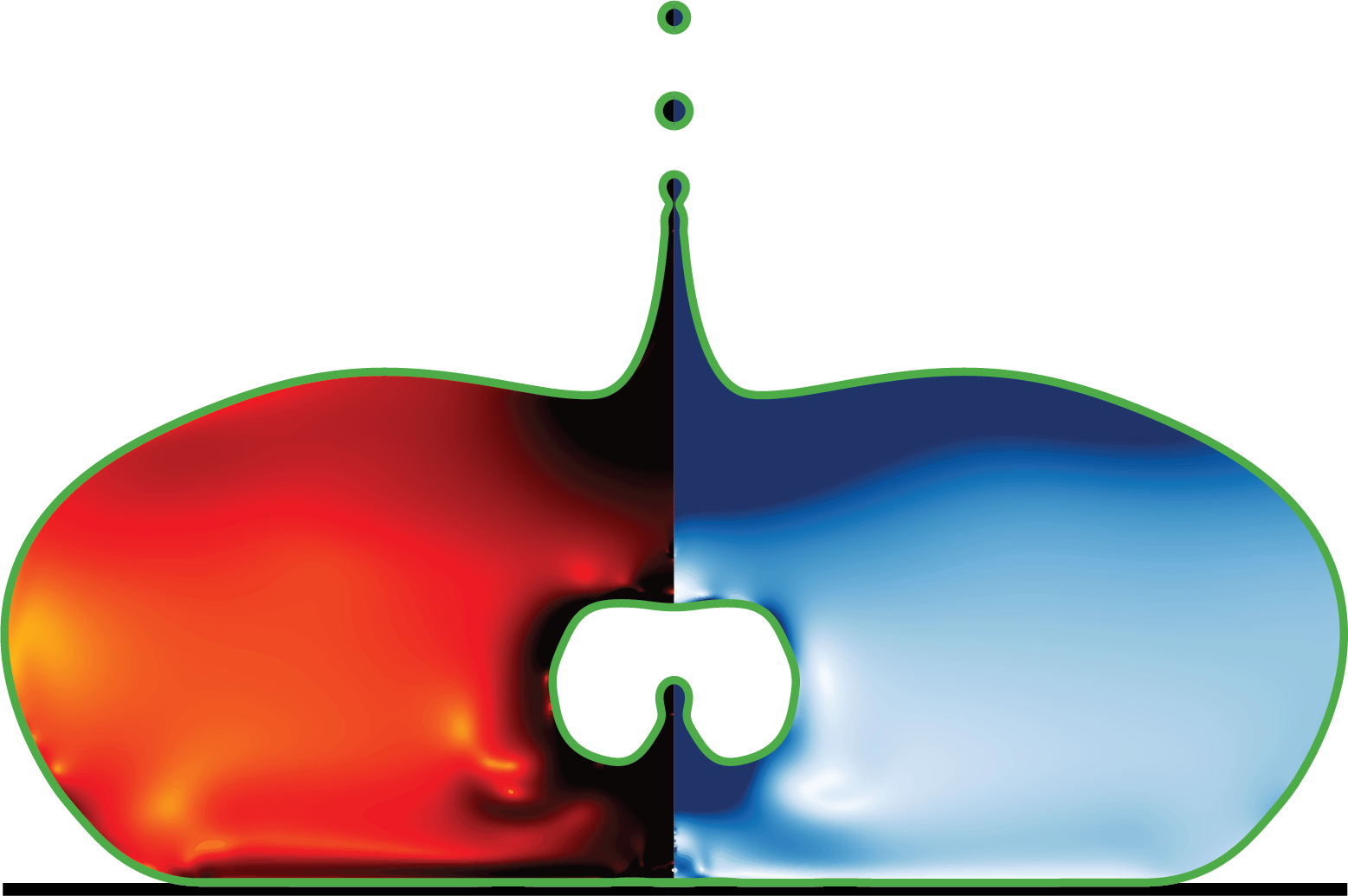
simulationCases/dropMove.c
dropMove.c: onset of self-propulsion of a chemically active drop
A single planar drop emits a chemical species at its
interface. The species is advected and diffuses in the
outer phase. The implemented law
sigma = 1/Ca + 4*cL increases surface
tension with concentration. Above a critical Péclet
number the isotropic state is unstable and the drop
self-propels. The problem is integrated in the Stokes
limit with the coupled level-set and volume-of-fluid
(CLSVOF) interface method and the integral formulation
of surface tension.
Non-dimensional groups
Oh: Ohnesorge number, entering only through the density \(\rho = 4/Oh^2\).Pe: Péclet number; the species diffusivity is \(D = 1/Pe\).Ca: the clean-interface surface tension is \(1/Ca\); the local coefficient is \(1/Ca + 4c\) with \(c\) the species concentration.AcNum: constant chemical flux emitted at the interface.
Runtime parameters
All parameters are read from a key=value
file passed as the first argument (default
case.params) through
src-local/params.h:
| Key | Default | Meaning |
|---|---|---|
CaseNo |
1000 | Case identifier used by the runner |
Pe |
1.6 | Péclet number |
MAXlevel, MINlevel |
8, 0 | Quadtree refinement bounds |
Oh, Ca,
AcNum |
1, 0.1, 1 | Fixed non-dimensional groups |
L0 |
10 | Square domain size in drop radii |
tmax, tsnap |
50, 0.1 | Observation horizon and snapshot interval |
threshold |
1 | Centroid displacement, in drop radii, classified as
MOVED; <= 0 disables the
early stop |
FErr, VelErr,
cErr, KErr |
1e-3 each | Wavelet adaptation tolerances |
keLimit |
1e3 | Kinetic-energy limit classified as
FAILED |
Output and classification
Snapshots are written to
intermediate/snapshot-<t> and the
diagnostics to log.dat with columns
i t ke dist xcm ycm volume in the working
directory (the runner uses
simulationCases/c<CaseNo>/). Exactly
one STATUS {MOVED,NOT_MOVED,FAILED} line
and one SUMMARY key=value line are printed
on stdout when the run ends. MOVED is a
finite-time, finite-displacement convention: the
centroid moved by more than threshold
before tmax. The centroid, drop volume and
kinetic energy are integrated with the cell volume
dv() so that the adaptive mesh does not
bias the classifier; displacement is measured from the
centroid recorded at the first step.
Author
Vatsal Sanjay Email: [email protected] Computational Multiphase Physics (CoMPhy) Lab, Durham University Last updated: Sep 9, 2026
#include <sys/stat.h>
#include <errno.h>
#include "navier-stokes/centered.h"
#define FILTERED 1
61
#include "two-phase-clsvof.h"
#include "integral.h"
#include "activity.h"
#include "params.h"Fields and boundary conditions
cL is the species concentration in the
outer phase (cL.inverse = true),
sigmaf the surface tension coefficient and
KAPPA the distance-function curvature used
for adaptation. All walls are no-slip with zero
concentration.
scalar cL[], * stracers = {cL};
scalar sigmaf[];
scalar KAPPA[];

cL[top] = dirichlet(0.);
cL[right] = dirichlet(0.);
cL[left] = dirichlet(0.);
cL[bottom] = dirichlet(0.);

u.t[top] = dirichlet(0.);
u.t[right] = dirichlet(0.);
u.t[left] = dirichlet(0.);
u.t[bottom] = dirichlet(0.);
Runtime parameters
int CaseNo = 1000;
double Pe = 1.6;
int MAXlevel = 8, MINlevel = 0;
double Oh = 1., Ca = 0.1, AcNum = 1.;
double tmax = 50., tsnap = 0.1;
double movement_threshold = 1.0;
double FErr = 1e-3, VelErr = 1e-3, cErr = 1e-3, KErr = 1e-3;
double keLimit = 1e3;
Classifier state
static double x0_cm = 0., y0_cm = 0.;
static bool centroid_initialised = false;
static bool status_printed = false;
static int exit_status = 0;
static double dist_last = 0., xcm_last = 0., ycm_last = 0.;
print_status()
Prints the single STATUS line and the
SUMMARY line on rank zero, once.
static void print_status (const char * status, int i_now, double t_now)
{
  if (status_printed || pid() != 0)
    return;
  status_printed = true;
  fprintf (stdout, "STATUS %s\n", status);
  fprintf (stdout,
           "SUMMARY CaseNo=%d Pe=%g max_level=%d tmax=%g threshold=%g"
           " t_end=%g i_end=%d dist_end=%.8e xcm_end=%.8e ycm_end=%.8e"
           " status=%s\n",
           CaseNo, Pe, MAXlevel, tmax, movement_threshold,
           t_now, i_now, dist_last, xcm_last, ycm_last, status);
  fflush (stdout);
}
ensure_directory()
Creates path with mkdir(2);
an existing directory is accepted.
static bool ensure_directory (const char * path)
{
  if (mkdir (path, 0775) != 0 && errno != EEXIST)
    return false;
  struct stat st;
  return stat (path, &st) == 0 && S_ISDIR (st.st_mode);
}
main()
Reads the parameter file, validates the values that must be positive, sets up the domain and material properties and runs the simulation.
int main (int argc, char const * argv[])
{
  params_init_from_argv (argc, argv);

  CaseNo = param_int ("CaseNo", CaseNo);
  Pe = param_double ("Pe", Pe);
  MAXlevel = param_int ("MAXlevel", MAXlevel);
  MINlevel = param_int ("MINlevel", MINlevel);
  Oh = param_double ("Oh", Oh);
  Ca = param_double ("Ca", Ca);
  AcNum = param_double ("AcNum", AcNum);
  double L0_param = param_double ("L0", 10.);
  tmax = param_double ("tmax", tmax);
  tsnap = param_double ("tsnap", tsnap);
  movement_threshold = param_double ("threshold", movement_threshold);
  FErr = param_double ("FErr", FErr);
  VelErr = param_double ("VelErr", VelErr);
  cErr = param_double ("cErr", cErr);
  KErr = param_double ("KErr", KErr);
  keLimit = param_double ("keLimit", keLimit);

  if (!(Pe > 0.) || !(Oh > 0.) || !(Ca > 0.) || !(L0_param > 0.) ||
      !(tmax > 0.) || !(tsnap > 0.) || !(keLimit > 0.) ||
      MAXlevel < 1 || MAXlevel > 20 || MINlevel < 0 || MINlevel > MAXlevel) {
    fprintf (stderr, "Invalid parameters: Pe, Oh, Ca, L0, tmax, tsnap and keLimit"
             " must be positive and 0 <= MINlevel <= MAXlevel <= 20.\n");
    return 2;
  }

  if (pid() == 0 && !ensure_directory ("intermediate")) {
    fprintf (stderr, "Cannot create output directory 'intermediate'.\n");
    return 2;
  }

  stokes = true;
  L0 = L0_param;
  origin (-0.5*L0, -0.5*L0);
  init_grid (1 << MAXlevel);

  d.sigmaf = sigmaf;

  rho1 = 4./sq(Oh); rho2 = 4./sq(Oh);
  mu1 = 1.0; mu2 = 1.0;

  cL.inverse = true;
  cL.A = AcNum;
  cL.D = 1./Pe;

  if (pid() == 0)
    fprintf (stderr, "CaseNo=%d Pe=%g MAXlevel=%d MINlevel=%d Oh=%g Ca=%g AcNum=%g"
             " L0=%g tmax=%g tsnap=%g threshold=%g\n",
             CaseNo, Pe, MAXlevel, MINlevel, Oh, Ca, AcNum, L0, tmax, tsnap,
             movement_threshold);

  run();
  return exit_status;
}
Initialisation
Signed distance to a unit circle centred at the
origin; the CLSVOF header derives the volume fraction
from d.
event init (i = 0) {
  foreach() {
    d[] = 1. - sqrt (sq(x) + sq(y));
    u.x[] = 0.0;
    u.y[] = 0.0;
    cL[] = 0.;
    sigmaf[] = 1./Ca + 4.*cL[];
  }
}
Surface tension coefficient from the local concentration
event properties (i++) {
  foreach()
    sigmaf[] = 1./Ca + 4.*cL[];
}
Adaptation
Wavelet adaptation on the volume fraction, velocity, concentration and the distance-function curvature.
event adapt (i++) {
  foreach()
    KAPPA[] = distance_curvature (point, d);
  adapt_wavelet ({f, u.x, u.y, cL, KAPPA},
                 (double[]){FErr, VelErr, VelErr, cErr, KErr},
                 MAXlevel, MINlevel);
}
Snapshots
event outputs (t = 0.; t += tsnap; t <= tmax) {
  char dumpFile[128];
  snprintf (dumpFile, sizeof(dumpFile), "intermediate/snapshot-%5.4f", t);
  dump (file = dumpFile);
}
Diagnostics and onset classifier
Kinetic energy, drop volume and the volume-weighted
centroid are reduced with dv(). The run
stops with STATUS FAILED if the drop volume
vanishes or the kinetic energy is non-finite or exceeds
keLimit, and with STATUS MOVED
once the displacement from the initial centroid exceeds
threshold (when
threshold > 0).
event logWriting (i++) {
  double ke = 0., drop_volume = 0., x_moment = 0., y_moment = 0.;
  foreach (reduction(+:ke) reduction(+:drop_volume)
           reduction(+:x_moment) reduction(+:y_moment)) {
    double ff = clamp (f[], 0., 1.);
    ke += 0.5*rho(ff)*(sq(u.x[]) + sq(u.y[]))*dv();
    drop_volume += ff*dv();
    x_moment += ff*x*dv();
    y_moment += ff*y*dv();
  }

  if (!(drop_volume > 0.)) {
    if (pid() == 0)
      fprintf (stderr, "Drop volume vanished at i=%d, t=%g.\n", i, t);
    print_status ("FAILED", i, t);
    exit_status = 3;
    return 1;
  }

  xcm_last = x_moment/drop_volume;
  ycm_last = y_moment/drop_volume;
  if (!centroid_initialised) {
    x0_cm = xcm_last, y0_cm = ycm_last;
    centroid_initialised = true;
  }
  dist_last = sqrt (sq(xcm_last - x0_cm) + sq(ycm_last - y0_cm));

  if (pid() == 0) {
    static FILE * fp = NULL;
    static bool log_header_written = false;
    if (!log_header_written) {
      log_header_written = true;
      fp = fopen ("log.dat", "w");
      if (fp)
        fprintf (fp, "i t ke dist xcm ycm volume\n");
      else
        fprintf (stderr, "Cannot open log.dat for writing.\n");
      fprintf (ferr, "i t ke dist xcm ycm volume\n");
    }
    fprintf (ferr, "%d %g %.8e %.8e %.8e %.8e %.8e\n",
             i, t, ke, dist_last, xcm_last, ycm_last, drop_volume);
    if (fp) {
      fprintf (fp, "%d %g %.8e %.8e %.8e %.8e %.8e\n",
               i, t, ke, dist_last, xcm_last, ycm_last, drop_volume);
      fflush (fp);
    }
  }

  if (!isfinite (ke) || (i > 10 && ke >= keLimit)) {
    if (pid() == 0)
      fprintf (stderr, "Kinetic energy %.8e at i=%d, t=%g: stopping.\n",
               ke, i, t);
    print_status ("FAILED", i, t);
    exit_status = 3;
    return 1;
  }

  if (movement_threshold > 0. && i > 10 && dist_last >= movement_threshold) {
    print_status ("MOVED", i, t);
    return 1;
  }
}
End of the observation window
event end (t = tmax) {
  print_status ("NOT_MOVED", i, t);
}