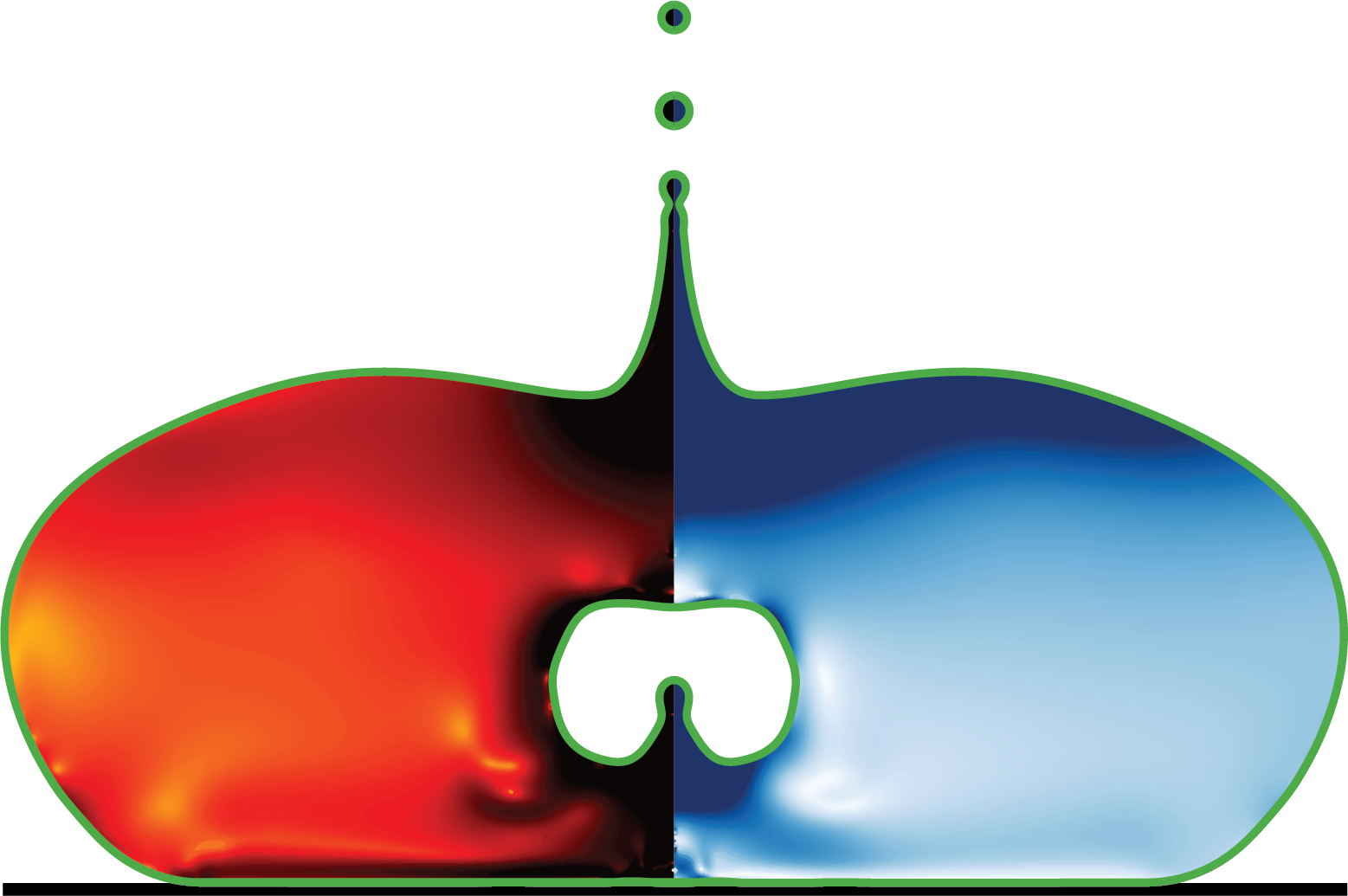
simulationCases/burstingBubble.c
Bursting Bubbles in Newtonian Fluids Simulation
This simulation models the dynamics of bursting bubbles in Newtonian fluids using the Basilisk framework. It focuses on the formation of Worthington jets and droplets that emerge during the bursting process.
Physics Overview
The simulation implements a two-phase axisymmetric flow model with adaptive mesh refinement and adaptive (surface-tension-limited) time stepping. A bubble initially at rest bursts at a free surface, creating a cavity collapse and subsequent jet formation.
Usage
Preferred (parameter-file mode):
./burstingBubble case.params [key=value ...]The simulation reads every knob from
case.params (see
default.params for the documented
template). Trailing key=value tokens
override the file, e.g. the Stage 1 restart run uses
./burstingBubble case.params tmax=0.10.
Legacy positional mode (new resolution knobs take defaults):
./burstingBubble <MAXlevel> <Oh> <Bond> <tmax> <zWall>See src-local/params.h for the full
parameter list, defaults, and validation rules.
@file burstingBubble.c @author Vatsal Sanjay @version 2.0 @date Jan 04, 2025
#include "axi.h"
#include "navier-stokes/centered.h"
Solver Configuration
FILTERED: Enable density and viscosity jump smoothing
#define FILTERED 1 // Smear density and viscosity jumps
#include "two-phase.h"
#include "navier-stokes/conserving.h"
#include "tension.h"

#if !_MPI
#include "distance.h"
#endif
Runtime Parameters
All configuration is read at runtime from
case.params via the C-side parameter layer.
Adaptive space (levels, wavelet tolerances) and adaptive
time (CFL, dtmax ceiling, solver tolerance) are now
tunable knobs rather than compile-time constants — see
src-local/params.h.
#include "params.h"

struct SimulationParams params;

// Boundary conditions - outflow on the right boundary
u.n[right] = neumann(0.);
p[right] = dirichlet(0.);

// Boundary conditions - solid wall at left boundary (bottom)
f[left] = dirichlet(1.0);      // Liquid at wall
u.n[left] = dirichlet(0.0);    // No-slip normal
u.t[left] = dirichlet(0.0);    // No-slip tangential

// Mesh control (set from params in main)
int MAXlevel, MINlevel;

// Physical parameters (set from params in main):
//   Oh  -> Ohnesorge number (liquid)
//   Oha -> Ohnesorge number (gas) = OhRatio * Oh
double Oh, Oha, Bond, tmax;

// Domain parameters:
//   zWall   -> distance from bubble south pole to bottom wall
//   Ldomain -> computed domain size: min(zWall + 6.0, 16.0)
double zWall, Ldomain;

// Adaptive-resolution controls (set from params in main):
//   fErr/VelErr/KErr -> wavelet error tolerances (VOF, velocity, curvature)
double fErr, VelErr, KErr;

// tsnap -> snapshot/restart dump interval. Needs a non-zero static initial
// value: Basilisk classifies event expressions (e.g. `t += tsnap`) before
// main() runs, and a zero increment would be misread as a second condition.
// main() overrides this with params.tsnap for the actual firing interval.
double tsnap = 1e-2;

char nameOut[80], dumpFile[80];
Main Function
Reads parameters, configures the domain and fluid properties, and starts the run.
- Parses
case.params(or legacy positional CLI) intoparams - Validates the configuration before allocating the grid
- Sets up the physical domain with appropriate dimensions
- Configures fluid properties for both phases
- Maps the adaptive space/time knobs onto Basilisk’s solver globals
int main(int argc, char *argv[]) {
// Parse and validate runtime configuration
if (params_init(argc, argv, ¶ms) != 0)
return 1;
if (!validate_params(¶ms)) {
fprintf(ferr, "ERROR: Invalid parameters. Aborting.\n");
return 1;
}
// Map physical parameters onto module globals
MAXlevel = params.MAXlevel;
MINlevel = params.MINlevel;
Oh = params.Oh;
Oha = params.OhRatio * params.Oh;
Bond = params.Bond;
tmax = params.tmax;
zWall = params.zWall;
fErr = params.fErr;
VelErr = params.VelErr;
KErr = params.KErr;
tsnap = params.tsnap;
// Calculate domain size: Ldomain = min(zWall + 6.0, 16.0)
// zWall = distance from bubble south pole to bottom wall
// +2.0 buffer below bubble, +4.0 space above for jet
Ldomain = fmin(zWall + 6.0, 16.0);
L0 = Ldomain;
origin(-2.0 - zWall, 0.);
init_grid(1 << params.init_grid_level);Adaptive Time Control
Set the advective CFL and the timestep ceiling.
Surface tension is time-explicit, so
tension.h reduces the timestep each step to
the capillary-wave period
T = sqrt(rho_m * Delta_min^3 / (pi * sigma));
dtmax is therefore a safety ceiling and the
effective step is adaptive (it scales with the finest
cell size and the resolved physics).
  CFL = params.CFL;
  dtmax = params.dtmax;
  TOLERANCE = params.TOLERANCE;

  // Create a folder named intermediate where all the simulation snapshots are stored.
  char comm[80];
  sprintf(comm, "mkdir -p intermediate");
  system(comm);

  // Name of the restart file. See writingFiles event.
  sprintf(dumpFile, "restart");
Physical Properties Configuration
Sets up the material properties for both phases: -
rho1, rho2: Density of liquid
and gas phases - mu1, mu2:
Dynamic viscosity of liquid and gas phases
rho1 = 1., rho2 = 1e-3;
mu1 = Oh, mu2 = Oha;
f.sigma = 1.0;
if (pid() == 0)
print_params(¶ms, ferr);
run();
}Initialization Event
Sets up the initial conditions for the simulation.
The function attempts to restore from a dump file first. If that fails: - For MPI runs: Ends with an error - For non-MPI runs: Tries to load an initial shape from a data file, creates a distance field, and initializes the volume fraction
event init(t = 0) {
#if _MPI // This is for supercomputers without OpenMP support
  if (!restore(file = dumpFile)) {
    fprintf(ferr, "Cannot restored from a dump file!\n");
  }
#else  // Note that distance.h is incompatible with OpenMPI. So, the below code should not be used with MPI
  if (!restore(file = dumpFile)) {
    char filename[60];
    sprintf(filename, "DataFiles/Bo%5.4f.dat", Bond);
    FILE *fp = fopen(filename, "rb");
    if (fp == NULL) {
      fprintf(ferr, "There is no file named %s\n", filename);
      // Try in folder one level up
      sprintf(filename, "../DataFiles/Bo%5.4f.dat", Bond);
      fp = fopen(filename, "rb");
      if (fp == NULL) {
        fprintf(ferr, "There is no file named %s\n", filename);
        return 1;
      }
    }
    coord *InitialShape;
    InitialShape = input_xy(fp);
    fclose(fp);
    scalar d[];
    distance(d, InitialShape);

    while (adapt_wavelet((scalar *){f, d}, (double[]){1e-8, 1e-8}, MAXlevel).nf);

    // The distance function is defined at the center of each cell, we have
    // to calculate the value of this function at each vertex.
    vertex scalar phi[];
    foreach_vertex() {
      phi[] = -(d[] + d[-1] + d[0,-1] + d[-1,-1])/4.;
    }

    // We can now initialize the volume fraction of the domain.
    fractions(phi, f);
  }
#endif
}
Adaptive Mesh Refinement
Refines the mesh based on gradients of key fields: - Volume fraction - Velocity components - Curvature
The wavelet error tolerances (fErr,
VelErr, KErr) and the
refinement band (MINlevel to
MAXlevel) are runtime parameters. The
interface is always resolved to MAXlevel
through the fErr criterion, while
MINlevel sets how coarse the far field is
allowed to become.
event adapt(i++) {
  scalar KAPPA[];
  curvature(f, KAPPA);

  adapt_wavelet((scalar *){f, u.x, u.y, KAPPA},
    (double[]){fErr, VelErr, VelErr, KErr},
    MAXlevel, MINlevel);
}
Output Management
Creates periodic snapshots of the simulation state. -
Dumps restart files for simulation recovery - Saves
intermediate snapshots at regular intervals defined by
tsnap
event writingFiles(t = 0; t += tsnap; t <= tmax) {
  dump(file = dumpFile);
  sprintf(nameOut, "intermediate/snapshot-%5.4f", t);
  dump(file = nameOut);
}
Simulation Termination
Writes a final summary of the simulation parameters when the simulation ends.
event end(t = end) {
  if (pid() == 0)
    fprintf(ferr, "Level %d, Oh %2.1e, Oha %2.1e, Bo %4.3f, zWall %g, Ldomain %g\n",
            MAXlevel, Oh, Oha, Bond, zWall, Ldomain);
}
Simulation Logging
Records key simulation data at each timestep: - Iteration number - Timestep size - Current simulation time - Kinetic energy
Also performs safety checks: - Monitors kinetic energy for stability - Terminates simulation if energy becomes too high or too low - Creates log files for post-processing analysis
event logWriting(i++) {
  // Calculate kinetic energy
  double ke = 0.;
  foreach(reduction(+:ke)) {
    ke += (2*pi*y)*(0.5*rho(f[])*(sq(u.x[]) + sq(u.y[])))*sq(Delta);
  }

  if (pid() == 0) {
    static FILE *fp;
    if (i == 0) {
      fprintf(ferr, "Level %d, Oh %2.1e, Oha %2.1e, Bo %4.3f, zWall %g, Ldomain %g\n",
              MAXlevel, Oh, Oha, Bond, zWall, Ldomain);
      fprintf(ferr, "i dt t ke\n");
      fp = fopen("log", "w");
      fprintf(fp, "Level %d, Oh %2.1e, Oha %2.1e, Bo %4.3f, zWall %g, Ldomain %g\n",
              MAXlevel, Oh, Oha, Bond, zWall, Ldomain);
      fprintf(fp, "i dt t ke\n");
      fprintf(fp, "%d %g %g %g\n", i, dt, t, ke);
      fclose(fp);
    } else {
      fp = fopen("log", "a");
      fprintf(fp, "%d %g %g %g\n", i, dt, t, ke);
      fclose(fp);
    }
    fprintf(ferr, "%d %g %g %g\n", i, dt, t, ke);

    assert(ke > -1e-10);

    // Check for energy blowup (numerical instability)
    if (ke > 1e2 && i > 1e1) {
      if (pid() == 0) {
        fprintf(ferr, "The kinetic energy blew up. Stopping simulation\n");
        fp = fopen("log", "a");
        fprintf(fp, "The kinetic energy blew up. Stopping simulation\n");
        fclose(fp);
        dump(file = dumpFile);
        return 1;
      }
    }
    assert(ke < 1e2);

    // Check for energy dissipation below threshold
    if (ke < 1e-6 && i > 1e1) {
      if (pid() == 0) {
        fprintf(ferr, "kinetic energy too small now! Stopping!\n");
        dump(file = dumpFile);
        fp = fopen("log", "a");
        fprintf(fp, "kinetic energy too small now! Stopping!\n");
        fclose(fp);
        return 1;
      }
    }
  }
}