simulationCases/dropImpact_legacy.c
dropImpact_legacy.c
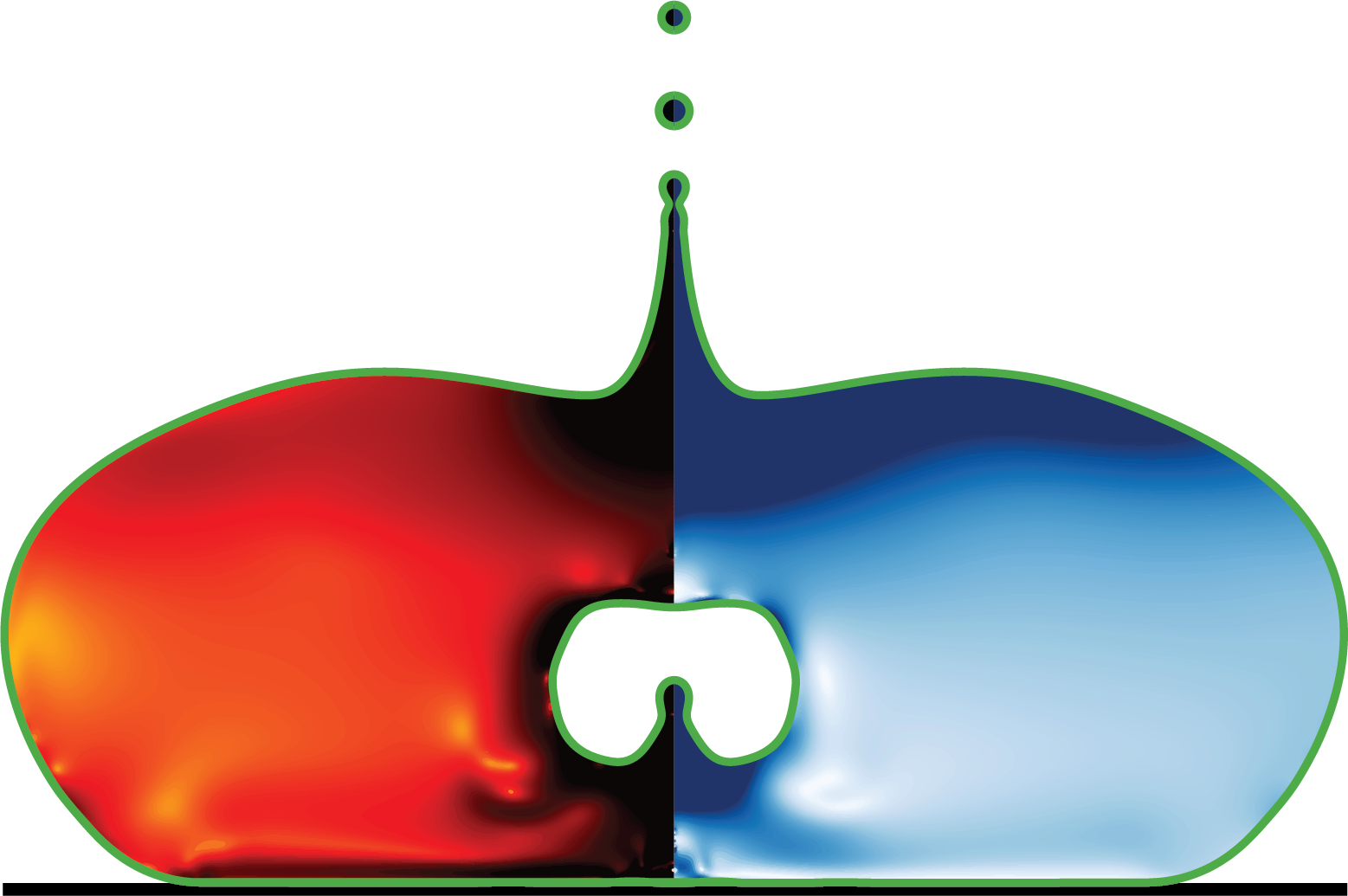
Legacy axisymmetric drop-impact simulation in a single Basilisk file.
Usage (legacy CLI)
./dropImpact_legacy <MAXlevel> <tmax> <We> <Ohd> <Ohs> <Ldomain>Notes
- Uses fixed error tolerances and a hard-coded initial drop location.
- Writes snapshots to
intermediate/and logs tolog.
Author
Vatsal Sanjay ([email protected]) CoMPhy Lab, Durham University Original date: 2022-02-08
// 1 is drop
#include "axi.h"
#include "navier-stokes/centered.h"
#define FILTERED
#include "two-phase.h"
#include "navier-stokes/conserving.h"
#include "tension.h"

// Error tolerances
#define fErr (1e-3)                                 // error tolerance in VOF
#define KErr (1e-6)                                 // error tolerance in KAPPA
#define VelErr (1e-2)                            // error tolerances in velocity

// air-water
#define Rho21 (1e-3)
// Calculations!
#define Xdist (1.02)
#define R2Drop(x,y) (sq(x - Xdist) + sq(y))

// boundary conditions
u.t[left] = dirichlet(0.0);
f[left] = dirichlet(0.0);
u.n[right] = neumann(0.);
p[right] = dirichlet(0.0);
u.n[top] = neumann(0.);
p[top] = dirichlet(0.0);

int MAXlevel;
double tmax, We, Ohd, Ohs, Bo, Ldomain;
#define MINlevel// maximum level
#define tsnap (0.01)

int main(int argc, char const *argv[]) {
  if (argc < 7){
    fprintf(ferr, "Lack of command line arguments. Check! Need %d more arguments\n",8-argc);
    return 1;
  }

  MAXlevel = atoi(argv[1]);
  tmax = atof(argv[2]);
  We = atof(argv[3]); // We is 1 for 0.22 m/s <1250*0.22^2*0.001/0.06>
  Ohd = atof(argv[4]); // <\mu/sqrt(1250*0.060*0.001)>
  Ohs = atof(argv[5]); //\mu_r * Ohd
  Ldomain = atof(argv[6]); // size of domain. must keep Ldomain \gg

  fprintf(ferr, "Level %d tmax %g. We %g, Ohd %3.2e, Ohs %3.2e, Bo %g, Lo %g\n", MAXlevel, tmax, We, Ohd, Ohs, Bo, Ldomain);

  L0=Ldomain;
  X0=0.; Y0=0.;
  init_grid (1 << (6));

  char comm[4096];
  snprintf(comm, sizeof(comm), "mkdir -p intermediate");
  system(comm);

  rho1 = 1.0; mu1 = Ohd/sqrt(We);
  rho2 = Rho21; mu2 = Ohs/sqrt(We);
  f.sigma = 1.0/We;

  run();
}

event init(t = 0){
  if(!restore (file = "restart")){
    refine((R2Drop(x,y) < 1.05) && (level < MAXlevel));
    fraction (f, 1. - R2Drop(x,y));
    foreach () {
      u.x[] = -1.0*f[];
      u.y[] = 0.0;
    }
  }
}


event adapt(i++){
  scalar KAPPA[];
  curvature(f, KAPPA);
  adapt_wavelet ((scalar *){f, KAPPA, u.x, u.y},
     (double[]){fErr, KErr, VelErr, VelErr},
      MAXlevel, MINlevel);

  unrefine(x>0.95*Ldomain || y>4e0); // ensure there is no backflow from the outflow walls!

}

// Outputs
// static
event writingFiles (t = 0, t += tsnap; t <= tmax) {
  dump (file = "restart");
  char nameOut[4096];
  snprintf(nameOut, sizeof(nameOut), "intermediate/snapshot-%5.4f", t);
  dump (file = nameOut);
}

event logWriting (i++) {
  double ke = 0.;
  foreach (reduction(+:ke)){
    ke += 2*pi*y*(0.5*rho(f[])*(sq(u.x[]) + sq(u.y[])))*sq(Delta);
  }
  static FILE * fp;
  if (i == 0) {
    fprintf (ferr, "i dt t ke p\n");
    fp = fopen ("log", "w");
    fprintf(fp, "Level %d tmax %g. We %g, Ohd %3.2e, Ohs %3.2e\n", MAXlevel, tmax, We, Ohd, Ohs);
    fprintf (fp, "i dt t ke\n");
    fprintf (fp, "%d %g %g %g\n", i, dt, t, ke);
    fclose(fp);
  } else {
    fp = fopen ("log", "a");
    fprintf (fp, "%d %g %g %g\n", i, dt, t, ke);
    fclose(fp);
  }
  fprintf (ferr, "%d %g %g %g\n", i, dt, t, ke);
}