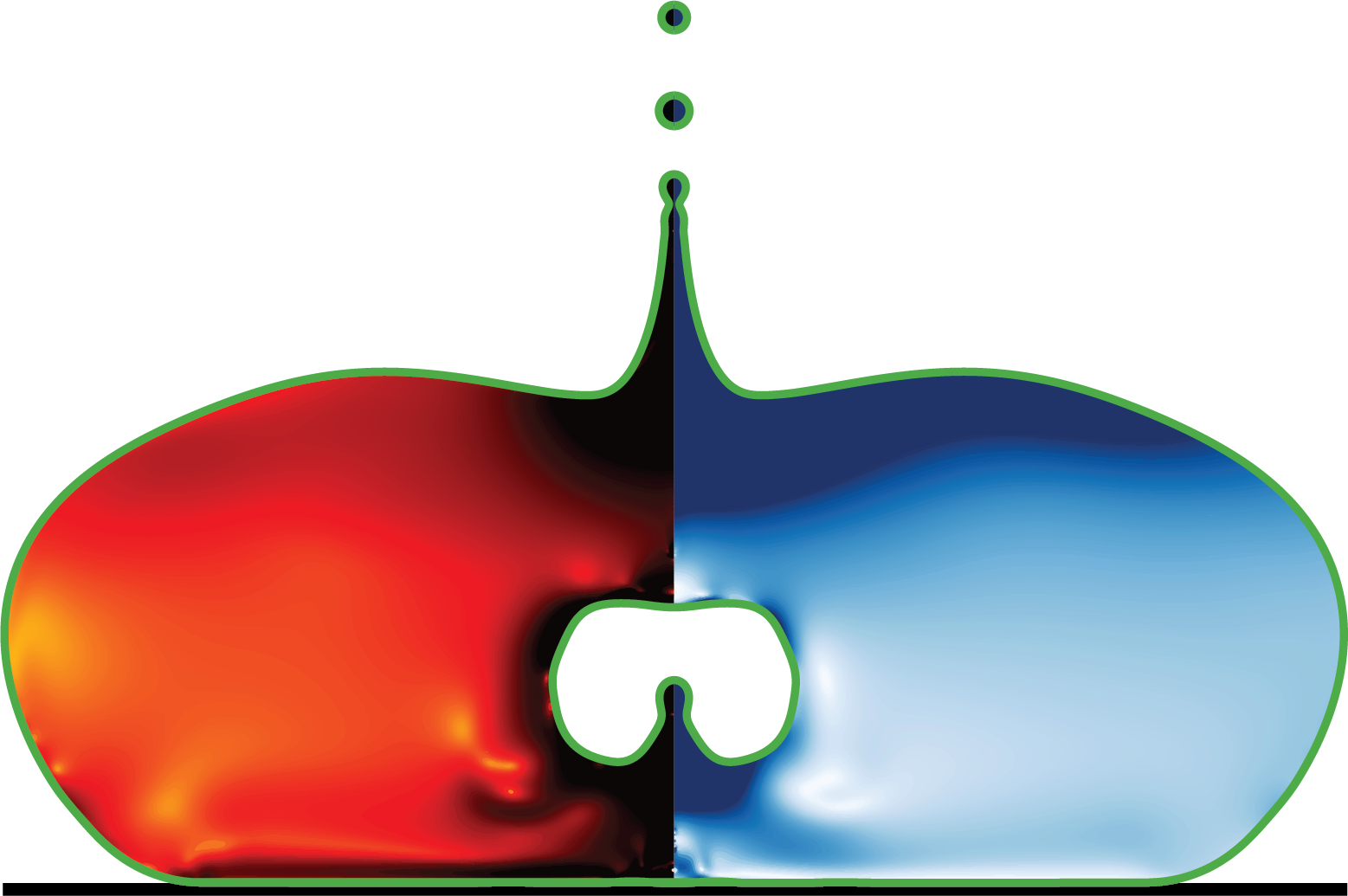
src-local/diagnostics.h
diagnostics.h
Statistics and output helpers for drop impact simulations.
Provides
- File handle management (open once, write many)
- Statistics calculations (kinetic energy, etc.)
- Snapshot management
- Extension hooks for additional diagnostics
Author
Vatsal Sanjay ([email protected]) CoMPhy Lab, Durham University
#ifndef DIAGNOSTICS_H
#define DIAGNOSTICS_H

#include "params.h"

// Global file handles (kept open for performance)
static FILE *log_fp = NULL;
open_log_files()
Open log files and write headers. The log file stays open for the entire simulation to avoid repeated open/close overhead.
Parameters
p: parameter structure
Returns
0on success-1on error
static inline int open_log_files(const struct SimulationParams *p) {
    // Create intermediate directory for snapshots
    char intermediate_dir[512];
    snprintf(intermediate_dir, sizeof(intermediate_dir), "%s/intermediate", p->output_dir);
    create_output_directory(intermediate_dir);

    // Open main log file
    char log_path[512];
    snprintf(log_path, sizeof(log_path), "%s/log", p->output_dir);

    log_fp = fopen(log_path, "w");
    if (!log_fp) {
        fprintf(stderr, "ERROR: Cannot open log file: %s\n", log_path);
        return -1;
    }

    // Write header with full parameter information
    fprintf(log_fp, "# Drop Impact Simulation Log\n");
    fprintf(log_fp, "# Parameters:\n");
    fprintf(log_fp, "#   We = %g, Ohd = %g, Ohs = %g\n", p->We, p->Ohd, p->Ohs);
    fprintf(log_fp, "#   rho_ratio = %g, Re = %g\n", p->rho_ratio, sqrt(p->We) / p->Ohd);
    fprintf(log_fp, "#   Ldomain = %g, MAXlevel = %d, MINlevel = %d\n",
            p->Ldomain, p->MAXlevel, p->MINlevel);
    fprintf(log_fp, "#   drop_position = (%g, %g), radius = %g\n",
            p->drop_x, p->drop_y, p->drop_radius);
    fprintf(log_fp, "#   impact_velocity = %g, tmax = %g\n", p->impact_velocity, p->tmax);
    fprintf(log_fp, "# Columns: iteration  dt  time  kinetic_energy\n");
    fflush(log_fp);

    fprintf(stderr, "Log file opened: %s\n", log_path);
    return 0;
}
calculate_kinetic_energy()
Return total kinetic energy integrated over the domain.
For axisymmetric flow:
KE = ∫ 2πy * 0.5 ρ (u_x^2 + u_y^2) dV
static inline double calculate_kinetic_energy(void) {
    double ke = 0.0;

    foreach(reduction(+:ke)) {
        // Axisymmetric volume element: 2πy * Δx * Δy
        // Density from VOF field f
        double rho_local = rho(f[]);
        double u_mag_sq = sq(u.x[]) + sq(u.y[]);
        ke += 2.0 * M_PI * y * (0.5 * rho_local * u_mag_sq) * sq(Delta);
    }

    return ke;
}
write_statistics()
Write iteration, timestep, time, and kinetic energy to the log file. The file handle stays open for performance.
Parameters
iter: current iteration numbertime: current simulation timetimestep: current timestep sizep: parameter structure
static inline void write_statistics(int iter, double time, double timestep,
                                     const struct SimulationParams *p) {
    if (!log_fp) {
        fprintf(stderr, "ERROR: Log file not open\n");
        return;
    }

    // Calculate statistics
    double ke = calculate_kinetic_energy();

    // Write to log file
    fprintf(log_fp, "%d %g %g %g\n", iter, timestep, time, ke);
    fflush(log_fp);  // Ensure data is written

    // Also write to stderr for monitoring
    if (iter == 0 || iter % 100 == 0) {
        fprintf(stderr, "i=%d  t=%g  dt=%g  KE=%g\n", iter, time, timestep, ke);
    }
}
save_snapshot()
Save simulation snapshots for restart and post-processing.
Parameters
time: current simulation timep: parameter structure
static inline void save_snapshot(double time, const struct SimulationParams *p) {
    char filename[512];

    // Save restart file in output directory
    snprintf(filename, sizeof(filename), "%s/restart", p->output_dir);
    dump(file = filename);

    // Save numbered snapshot in intermediate directory
    snprintf(filename, sizeof(filename), "%s/intermediate/snapshot-%5.4f", p->output_dir, time);
    dump(file = filename);

    fprintf(stderr, "Snapshot saved at t = %g\n", time);
}
close_log_files()
Close any open log files at the end of the simulation.
static inline void close_log_files(void) {
    if (log_fp) {
        fclose(log_fp);
        log_fp = NULL;
        fprintf(stderr, "Log file closed\n");
    }
}
Optional Diagnostics (ENABLE_ADVANCED_DIAGNOSTICS)
Placeholder routines for future extensions: - Drop spreading radius - Contact line position - Interface area - Pressure forces - Energy dissipation
#ifdef ENABLE_ADVANCED_DIAGNOSTICScalculate_spreading_radius()
Return the maximum radial extent of the drop.
static inline double calculate_spreading_radius(void) {
    double r_max = 0.0;

    foreach(reduction(max:r_max)) {
        if (f[] > 0.5) {  // Inside drop
            if (x > r_max) r_max = x;
        }
    }

    return r_max;
}
calculate_contact_line_y()
Return the contact line y-position (placeholder implementation).
static inline double calculate_contact_line_y(void) {
    double y_contact = 0.0;
    // Implementation depends on surface definition
    // Placeholder for future development
    return y_contact;
}
calculate_interface_area()
Return total interface area (2D: length, 3D: area).
static inline double calculate_interface_area(void) {
    double area = 0.0;

    foreach(reduction(+:area)) {
        // Interface area proportional to |∇f|
        double grad_f_mag = sqrt(sq((f[1,0] - f[-1,0])/(2.0*Delta)) +
                                 sq((f[0,1] - f[0,-1])/(2.0*Delta)));
        if (grad_f_mag > 0.1) {  // Near interface
            area += 2.0 * M_PI * y * grad_f_mag * sq(Delta);
        }
    }

    return area;
}

#endif // ENABLE_ADVANCED_DIAGNOSTICS

#endif // DIAGNOSTICS_H