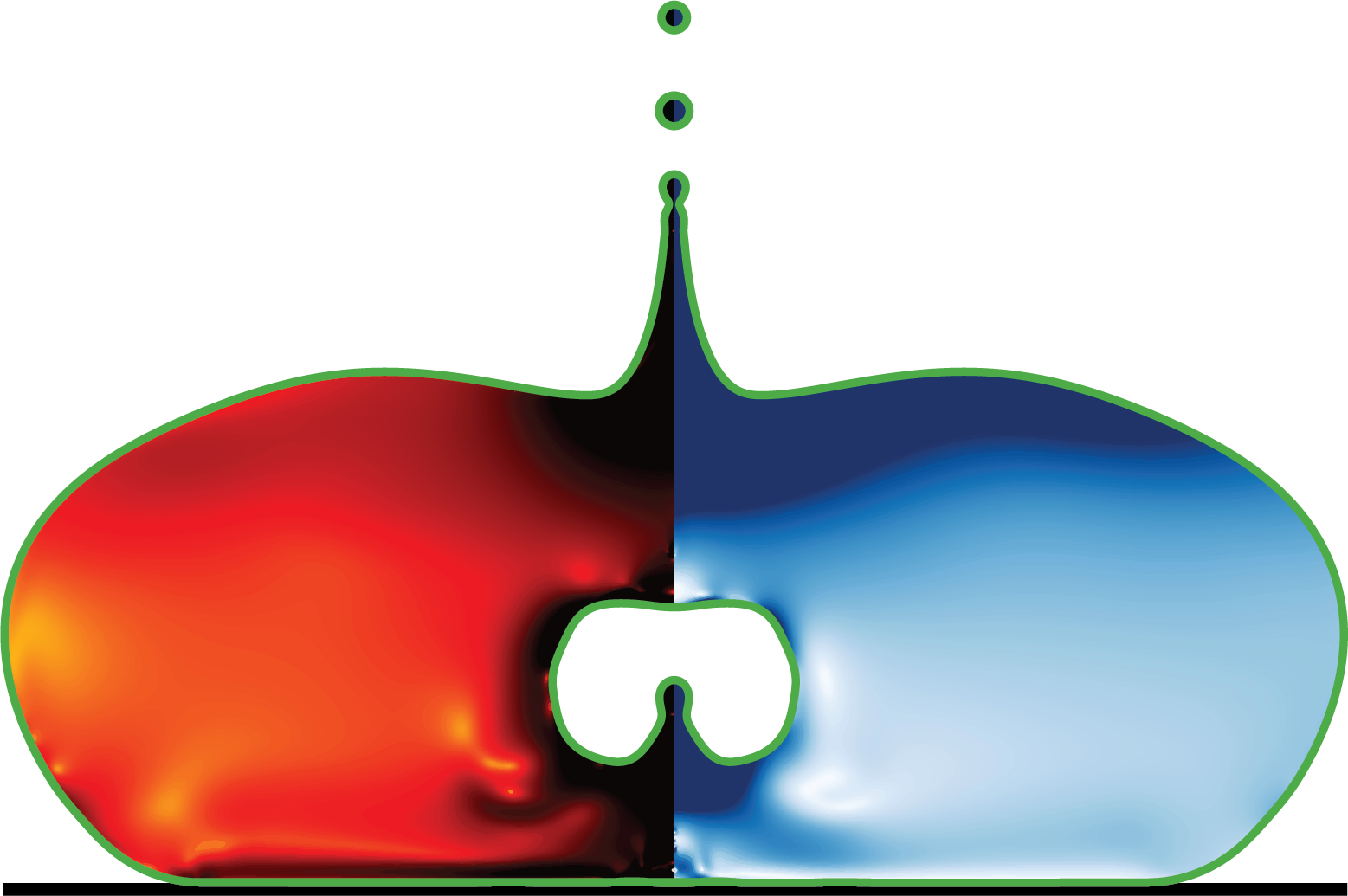
simulationCases/bubbleinSheet_02.c
// Bubbles inside a draining sheet. Three phase // Id 1 is liquid pool, and Id 2 is Newtonian gas.
#include “axi.h” #include “navier-stokes/centered.h” #define FILTERED // Smear density and viscosity jumps // #include “two-phase.h” #include “three-phase.h”
// #include “navier-stokes/conserving.h” #include “tension.h” #include “distance.h” // #include “adapt_wavelet_limited_v2.h”
#define tsnap (1e-1) // 0.001 only for some cases. // Error tolerancs #define fErr (1e-3) // error tolerance in f1 VOF #define KErr (1e-6) // error tolerance in VoF curvature calculated using heigh function method (see adapt event) #define VelErr (1e-3) // error tolerances in velocity – Use 1e-2 for low Oh and 1e-3 to 5e-3 for high Oh/moderate to high J
// Numbers! #define Ldomain 4
// Surface tensions #define SIGMA13 (1.0) #define SIGMA12 (1.0)
int MAXlevel; // Oh -> Solvent Ohnesorge number // Oha -> air Ohnesorge number // Bo -> Bond number = rhoR3w2/gamma
double Oh, Oha, Bo, tmax; char nameOut[80], dumpFile[80];
// boundary conditions u.n[right] = dirichlet(-2 * pow(Bo, 0.5) * x); u.t[right] = dirichlet(pow(Bo, 0.5) * y); p[right] = dirichlet(0.); pf[right] = dirichlet(0);
u.n[top] = dirichlet(pow(Bo, 0.5) * y); u.t[top] = dirichlet(-2 * pow(Bo, 0.5) * x); p[top] = dirichlet(0.); pf[top] = dirichlet(0);
int main(int argc, char const *argv[]) { dtmax = 1e-5; // BEWARE of this for stability issues.
L0 = Ldomain;
// Values taken from the terminal MAXlevel = atoi(argv[1]); Oh = atof(argv[2]); Bo = atof(argv[3]); tmax = atof(argv[4]);
// Ensure that all the variables were transferred properly from the terminal or job script. if (argc < 4) { fprintf(ferr, “Lack of command line arguments. Check! Need %d more arguments”, 4 - argc); return 1; } fprintf(ferr, “Level %d, Oh %2.1e, Bo %4.3f”, MAXlevel, Oh, Bo); init_grid(1 << 7); // Create a folder named intermediate where all the simulation snapshots are stored. char comm[80]; sprintf(comm, “mkdir -p intermediate”); system(comm); // Name of the restart file. See writingFiles event. sprintf(dumpFile, “dump”);
rho1 = 1., rho2 = 1e-3, rho3 = 1e-3; // Oha = 2e-2 * Oh; Oha = 2e-5; mu1 = Oh, mu2 = Oha, mu3 = Oha;
// f.sigma = 1.0; f1.sigma = SIGMA13; f2.sigma = SIGMA12;
run(); }
event init(t = 0) { if (!restore(file = dumpFile)) { fraction(f1, 1.2 - x * x); fraction(f2, 1 - x * x - y * y); foreach () { u.x[] = -2 * pow(Bo, 0.5) * x; u.y[] = pow(Bo, 0.5) * y; } // boundary ({f1,f2,u}); } // return 1; }
event adapt(i++) { scalar KAPPA1[], KAPPA2[]; curvature(f1, KAPPA1); curvature(f2, KAPPA2); adapt_wavelet((scalar *){f1, f2, u.x, u.y, KAPPA1, KAPPA2}, (double[]){fErr, fErr, VelErr, VelErr, KErr, KErr}, MAXlevel, MAXlevel - 6); }
event writingFiles(t = 0; t += tsnap; t <= tmax) { dump(file = dumpFile); sprintf(nameOut, “intermediate/snapshot-%5.4f”, t); dump(file = nameOut); }
event end(t = end) {}
// Log writing event logWriting(i++) { double ke = 0.; foreach (reduction(+ : ke)) { ke += (2 * pi * y) * (0.5 * rho(f1[], f2[]) * (sq(u.x[]) + sq(u.y[]))) * sq(Delta); } static FILE *fp; if (pid() == 0) { if (i == 0) { fprintf(ferr, “i dt t ke”); fp = fopen(“log”, “w”); fprintf(fp, “Level %d, Oh %2.1e, Bo %4.3f”, MAXlevel, Oh, Bo); fprintf(fp, “i dt t ke”); } else { fp = fopen(“log”, “a”); fprintf(fp, “%d %g %g %g”, i, dt, t, ke); } fprintf(fp, “%d %g %g %g”, i, dt, t, ke); fclose(fp); fprintf(ferr, “%d %g %g %g”, i, dt, t, ke); }
assert(ke > -1e-10); assert(ke < 1e2);
if ((ke > 1e2 || ke < 1e-6) && i > 1e1 && pid() == 0) { const char *message = ke > 1e2 ? “The kinetic energy blew up. Stopping simulation” : “kinetic energy too small now! Stopping!”; fprintf(ferr, “%s”, message); fp = fopen(“log”, “a”); fprintf(fp, “%s”, message); fclose(fp); dump(file = dumpFile); return 1; } }