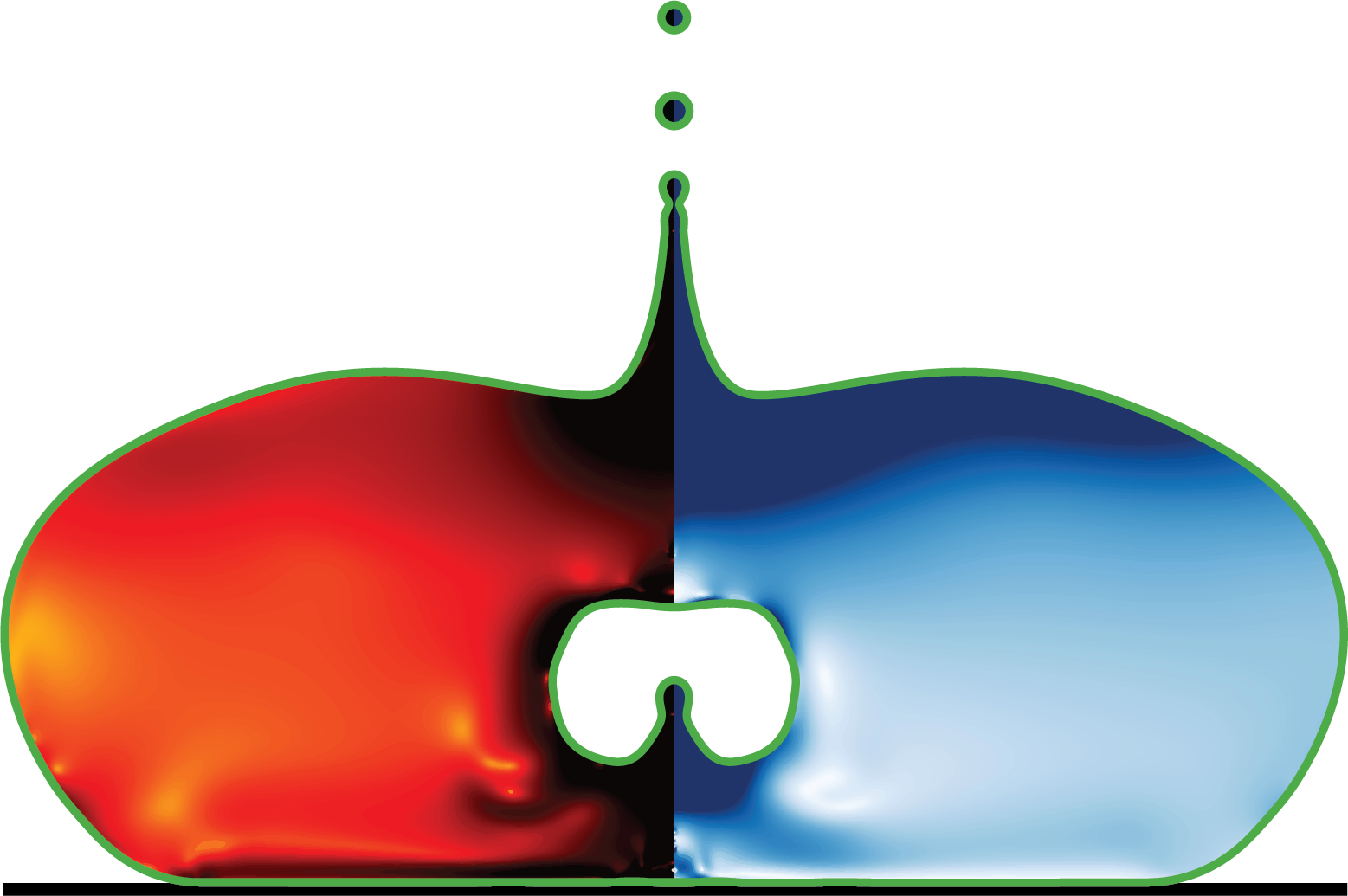
src-local/three-phase.h
Three-phase interfacial flows
This file helps setup simulations for flows of three fluids separated by corresponding interfaces (i.e. immiscible fluids). It is typically used in combination with a Navier–Stokes solver.
The interface between the fluids is tracked with a Volume-Of-Fluid method. The volume fraction in fluid i is \(f_i=1\) and \(f_i=0\) everywhere else. The densities and dynamic viscosities for fluid 1, 2 and 3 are rho1, mu1, rho2, mu2, and rho3, mu3 respectively.
#include "vof.h"
scalar f1[], f2[], *interfaces = {f1, f2};
double rho1 = 1., mu1 = 0., rho2 = 1., mu2 = 0., rho3 = 1., mu3 = 0.;
Auxilliary fields are necessary to define the (variable) specific volume \(\alpha=1/\rho\) as well as the cell-centered density.
face vector alphav[];
scalar rhov[];

event defaults (i = 0) {
  alpha = alphav;
  rho = rhov;
If the viscosity is non-zero, we need to allocate the face-centered viscosity field.
  if (mu1 || mu2)
    mu = new face vector;
}
The density and viscosity are defined using arithmetic averages by default. The user can overload these definitions to use other types of averages (i.e. harmonic).
#ifndef rho
#define rho(f1, f2) (clamp(f1*(1-f2), 0., 1.) * rho1 + clamp(f1*f2, 0., 1.) * rho2 + clamp((1-f1), 0., 1.) * rho3)
42
#endif
#ifndef mu
#define mu(f1, f2) (clamp(f1*(1-f2), 0., 1.) * mu1 + clamp(f1*f2, 0., 1.) * mu2 + clamp((1-f1), 0., 1.) * mu3)
45
#endifWe have the option of using some “smearing” of the density/viscosity jump.
#ifdef FILTERED
scalar sf1[], sf2[], *smearInterfaces = {sf1, sf2};
#else
#define sf1 f1
55
#define sf2 f2
56
scalar *smearInterfaces = {sf1, sf2};
#endif
event properties (i++) {
if (i > 1){
foreach(){
if ((f2[] > 0.5) && (f1[] < 0.5)){
f1[] = f2[];
}
}
}When using smearing of the density jump, we initialise sfi with the vertex-average of fi.
#ifdef FILTERED
  int counter1 = 0;
  for (scalar sf in smearInterfaces){
    counter1++;
    int counter2 = 0;
    for (scalar f in interfaces){
      counter2++;
      if (counter1 == counter2){
        // fprintf(ferr, "%s %s\n", sf.name, f.name);
      #if dimension <=
          foreach(){
            sf[] = (4.*f[] +
                2.*(f[0,1] + f[0,-1] + f[1,0] + f[-1,0]) +
                f[-1,-1] + f[1,-1] + f[1,1] + f[-1,1])/16.;
          }
      #else // dimension ==
          foreach(){
            sf[] = (8.*f[] +
                4.*(f[-1] + f[1] + f[0,1] + f[0,-1] + f[0,0,1] + f[0,0,-1]) +
                2.*(f[-1,1] + f[-1,0,1] + f[-1,0,-1] + f[-1,-1] +
                f[0,1,1] + f[0,1,-1] + f[0,-1,1] + f[0,-1,-1] +
                f[1,1] + f[1,0,1] + f[1,-1] + f[1,0,-1]) +
                f[1,-1,1] + f[-1,1,1] + f[-1,1,-1] + f[1,1,1] +
                f[1,1,-1] + f[-1,-1,-1] + f[1,-1,-1] + f[-1,-1,1])/64.;
          }
      #endif
      }
    }
  }
  #endif
#if TREE
  for (scalar sf in smearInterfaces){
    sf.prolongation = refine_bilinear;
    boundary ({sf});
  }
#endif

  foreach_face() {
    double ff1 = (sf1[] + sf1[-1])/2.;
    double ff2 = (sf2[] + sf2[-1])/2.;
This is a bit of fine tuning here. We might get places in the domain where density and viscosity go below those of air, we just make the properties at those locations equal to that of air
    // double rhoTemp = max(rho(ff1, ff2), rho3);
    // alphav.x[] = fm.x[]/rhoTemp;
    alphav.x[] = fm.x[]/rho(ff1, ff2);
    face vector muv = mu;
    // double muTemp = max(mu(ff1, ff2), mu3);
    // muv.x[] = fm.x[]*muTemp;
    muv.x[] = fm.x[]*mu(ff1, ff2);
  }
  foreach(){
    // double rhoTemp = max(rho(sf1[], sf2[]), rho3);
    // rhov[] = cm[]*rhoTemp;
    rhov[] = cm[]*rho(sf1[], sf2[]);
  }

#if TREE
  for (scalar sf in smearInterfaces){
    sf.prolongation = fraction_refine;
    boundary ({sf});
  }
#endif
}