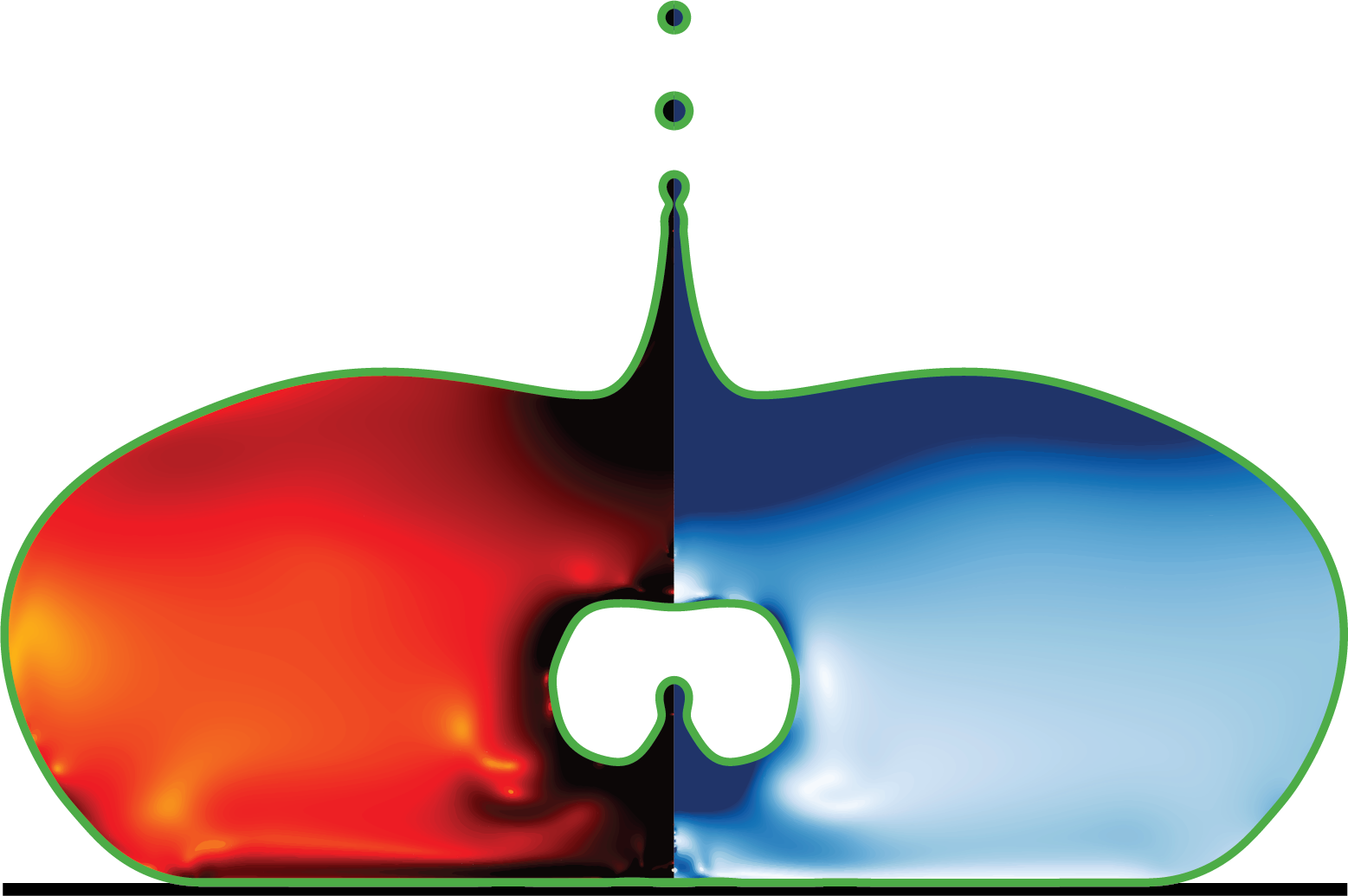
simulationCases/jumpingDrops_init.c
Jumping Drops - Initialization Phase
Creates the initial condition from STL geometry and
outputs a dumpInit file for continuation
with the main simulation phase.
Usage
./jumpingDrops_init [case.params]If no file is passed, the executable falls back to
case.params in the working directory.
Inputs
case.params: runtime parameter file withOh,Bo, andMAXlevelInitialCondition.stl: STL geometry file (must exist in working directory)
Outputs
dumpInit: Binary dump file containing initialized volume fraction fieldintermediate/: Directory for snapshot files
Dependencies
This file includes distance.h and
reduced.h for STL geometry handling, which
are not MPI-compatible. Run this phase
locally or on a single core to generate the initial
condition, then transfer dumpInit to the
compute environment for the main simulation.
Author
Vatsal Sanjay ([email protected])
CoMPhy Lab, Durham University
Last updated: 2026-01-30
Phase-Specific Includes
#include "distance.h"                 // STL geometry handling (NOT MPI-compatible)
#include "reduced.h"                  // Reduced gravity model
Common Definitions
Includes shared constants, tolerances, and helper functions.
#include "jumpingDrops_common.h"
#include "params.h"
Global Variable Definitions
Runtime parameters set from command-line arguments.
double tmax, Oh, Bo;
int MAXlevel;
Main Function
Loads runtime parameters from
case.params, sets fluid properties, and
starts the initialization run.
int main(int argc, char *argv[]) {
  if (!params_init_from_argv(argc, argv)) {
    fprintf(ferr, "Usage: %s [case.params]\n", argv[0]);
    return 1;
  }

  Oh = param_double("Oh", 1e-3);
  Bo = param_double("Bo", 1e-3);
  MAXlevel = param_int("MAXlevel", 10);

  // Initialization phase: short run just to create dump
  tmax = tsnap;

  // Initialize grid
  init_grid (1 << MINlevel);
  L0 = Ldomain;

  fprintf(ferr, "==============================================\n");
  fprintf(ferr, "Jumping Drops - Initialization Phase\n");
  fprintf(ferr, "==============================================\n");
  fprintf(ferr, "Parameter file = %s\n", params_source_path());
  fprintf(ferr, "tmax = %g (initialization run)\n", tmax);
  fprintf(ferr, "Oh = %g\n", Oh);
  fprintf(ferr, "Bo = %g\n", Bo);
  fprintf(ferr, "MAXlevel = %d\n", MAXlevel);
  fprintf(ferr, "==============================================\n\n");

  // Set fluid properties
  rho1 = 1.0;                         // liquid density (normalized)
  mu1 = Oh;                           // liquid viscosity
  rho2 = Rho21;                       // gas density
  mu2 = Mu21*Oh;                      // gas viscosity (consistent with main)
  f.sigma = 1.0;                      // surface tension (normalized)
  G.y = -Bo;                          // gravity (CRITICAL: must match main phase)

  // Create intermediate directory for snapshots
  char comm[80];
  sprintf (comm, "mkdir -p intermediate");
  system(comm);

  // Start simulation
  run();

  return 0;
}
Initialization Event
Loads STL geometry from
InitialCondition.stl, computes the distance
field, adapts the mesh, and converts the distance field
to a volume fraction field. The resulting state is saved
to dumpInit for use by the main
simulation.
event init(t = 0){
  if(!restore (file = "dumpInit")){
    char filename[60];
    sprintf(filename,"InitialCondition.stl");

    fprintf(ferr, "Loading STL geometry: %s\n", filename);

    FILE * fp = fopen (filename, "r");
    if (fp == NULL){
      fprintf(ferr, "ERROR: Cannot open STL file: %s\n", filename);
      return 1;
    }

    // Read STL geometry
    coord * p = input_stl (fp);
    fclose (fp);

    // Get bounding box
    coord min, max;
    bounding_box (p, &min, &max);

    fprintf(ferr, "STL bounding box:\n");
    fprintf(ferr, "  x: [%g, %g]\n", min.x, max.x);
    fprintf(ferr, "  y: [%g, %g]\n", min.y, max.y);
    fprintf(ferr, "  z: [%g, %g]\n", min.z, max.z);

    // Set origin to position drop correctly
    // Drop bottom at y = -1 with small offset for grid cell
    double origin_x = 0.;
    double origin_y = -1. - L0/pow(2, MAXlevel);
    double origin_z = (min.z + max.z)/2.;

    fprintf(ferr, "Setting origin: (%g, %g, %g)\n", origin_x, origin_y, origin_z);
    origin (origin_x, origin_y, origin_z);

    // Compute distance field from STL
    scalar d[];
    distance (d, p);

    // Adapt mesh based on distance field
    fprintf(ferr, "Adapting mesh based on STL geometry...\n");
    while (adapt_wavelet_limited ((scalar *){f, d},
                                   (double[]){1e-6, 1e-6*L0},
                                   refRegion,
                                   minlevel=MINlevel).nf);

    // Convert distance field to volume fraction
    vertex scalar phi[];
    foreach_vertex(){
      phi[] = (d[] + d[-1] + d[0,-1] + d[-1,-1] +
               d[0,0,-1] + d[-1,0,-1] + d[0,-1,-1] + d[-1,-1,-1])/8.;
    }
    fractions (phi, f);

    // Initialize velocity to zero
    foreach () {
      foreach_dimension(){
        u.x[] = 0.0;
      }
    }

    // Save initial condition
    dump (file = "dumpInit");
    fprintf(ferr, "Initial condition saved to dumpInit\n");
    fprintf(ferr, "==============================================\n\n");
  }
}