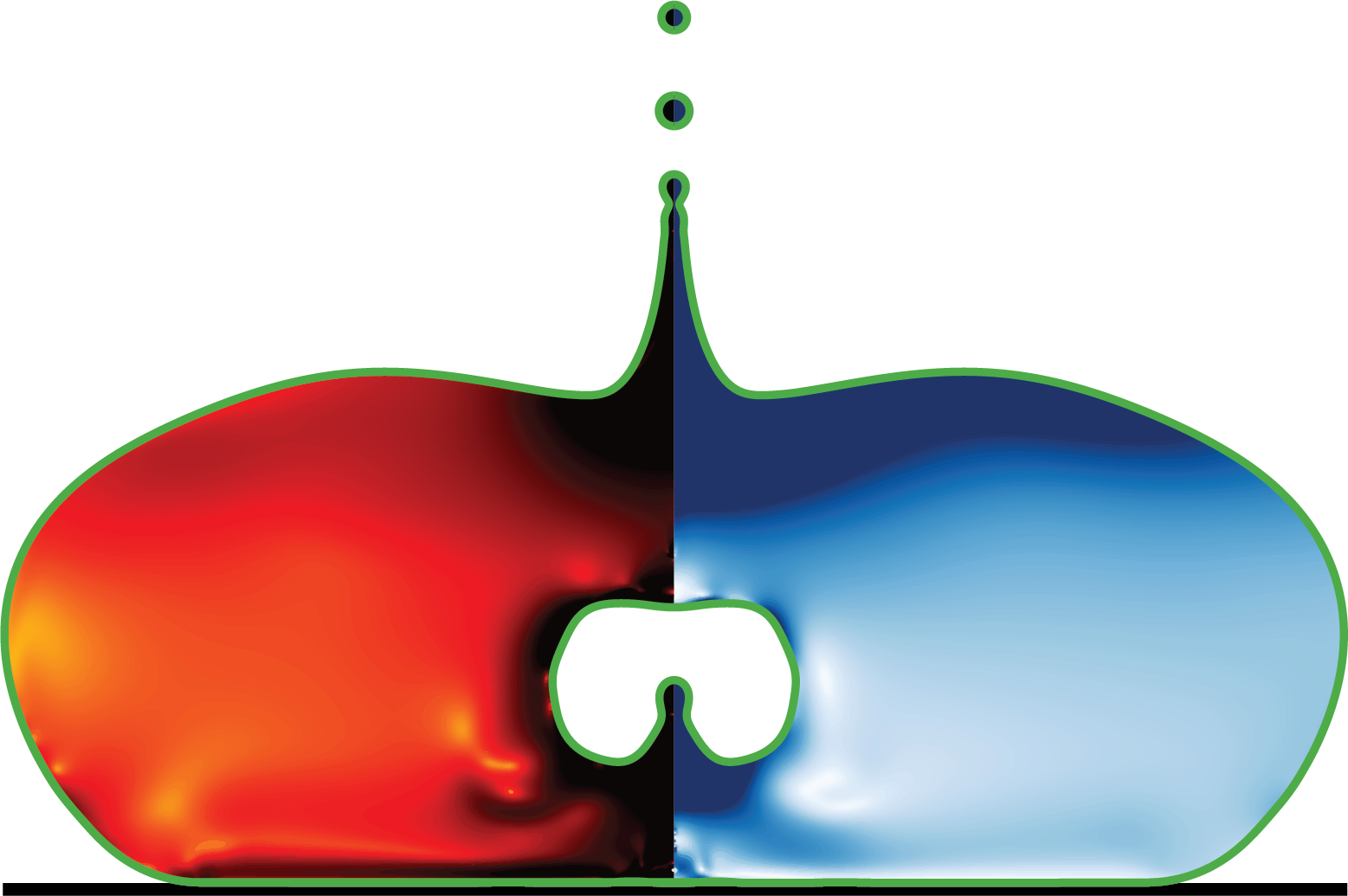
PinchOff: Plateau-Rayleigh Pinch-Off in Basilisk

Overview
PinchOff contains axisymmetric two-phase VOF
simulations of the Rayleigh-Plateau instability and
pinch-off scaling of a liquid cylinder. The cases
reproduce the similarity laws \(r_{min} \sim (t_0 -
t)^{2/3}\) and \(u_{max} \sim (t_0 -
t)^{-1/3}\) using adaptive mesh refinement and
interface tracking. Two variants are provided: an
inviscid setup (plateau-basilisk-website.c)
and a viscous setup
(plateau-viscous.c).
Background references: Popinet (2009) and Popinet & Antkowiak (2011).
Physics
Problem Description
A liquid cylinder of radius \(R = 0.2\) is perturbed by a
sinusoidal mode with wavenumber \(k = \pi\) and amplitude
\(A = 0.1\) in an
axisymmetric domain. Surface tension drives the
Rayleigh-Plateau instability, leading to necking,
pinch-off, and satellite drop formation. The interface
is tracked with a VOF field, and the mesh is refined to
keep at least five cells across the local radius up to
maxlevel = 18.
Governing Equations
The solver integrates the axisymmetric incompressible Navier-Stokes equations for two phases with surface tension:
\[\nabla \cdot \mathbf{u} = 0\]
\[\rho\left(\frac{\partial \mathbf{u}}{\partial t} + \mathbf{u} \cdot \nabla \mathbf{u}\right) = -\nabla p + \nabla \cdot (2\mu \mathbf{D}) + \sigma \kappa \delta_s \mathbf{n}\]
The VOF field \(f\) satisfies:
\[\frac{\partial f}{\partial t} + \mathbf{u} \cdot \nabla f = 0\]
Dimensionless Parameters and Defaults
The simulations are nondimensionalized with \(\sigma = 1\) and \(\rho_1 = 1\). Key defaults are:
| Parameter | Meaning | plateau-viscous | plateau-basilisk-website |
|---|---|---|---|
| \(\rho_1/\rho_2\) | Density ratio | 100 | 100 |
| \(\mu_1/\mu_2\) | Viscosity ratio | 100 | inviscid (default \(\mu = 0\)) |
| \(\sigma\) | Surface tension | 1 | 1 |
| \(R\) | Initial cylinder radius | 0.2 | 0.2 |
| \(k\) | Perturbation wavenumber | \(\pi\) | \(\pi\) |
| \(A\) | Perturbation amplitude | 0.1 | 0.1 |
maxlevel |
Max AMR level | 18 | 18 |
Basilisk (Required)
First-time install (or reinstall):
curl -sL https://raw.githubusercontent.com/comphy-lab/basilisk-C/main/reset_install_basilisk-ref-locked.sh | bash -s -- --ref=v2026-01-29 --hardSubsequent runs (reuses existing
basilisk/ if same ref):
curl -sL https://raw.githubusercontent.com/comphy-lab/basilisk-C/main/reset_install_basilisk-ref-locked.sh | bash -s -- --ref=v2026-01-29Note: Replace
v2026-01-29with the latest release tag from https://github.com/comphy-lab/basilisk-C/releases.
Set BASILISK to the Basilisk
src path and keep the Basilisk checkout
outside this repository:
# .project_config (gitignored)
export BASILISK=/path/to/basilisk/src
You can also export BASILISK directly in
your shell.
Repository Structure
├── simulationCases/
│   ├── plateau-basilisk-website.c
│   ├── plateau-viscous.c
│   ├── runCode.sh
│   └── Makefile
└── .github/                  Website assets and workflows
src-local/ and postProcess/
are not present currently.
Running the Code
Using Scripts (Recommended)
cd simulationCases

# MPI run (4 ranks) using the default script
./runCode.sh plateau-viscous

# Visualization build/run (single rank, OpenGL)
./runCode.sh --view plateau-viscous

# Inviscid variant
./runCode.sh plateau-basilisk-website
runCode.sh expects a
.project_config file in the repo root (used
to set BASILISK) and a working
qcc. The script defaults to
plateau; this repository does not include
plateau.c, so pass the case name
explicitly.
Manual Compilation
Basilisk Makefile (serial):
make -C simulationCases plateau-viscous
./simulationCases/plateau-viscous
Note: runCode.sh creates
simulationCases/<case>/ output
directories. In a clean clone,
make -C simulationCases <case> builds
an executable with the same name. If a directory with
that name already exists, prefer runCode.sh
or build into a different target name.
Serial qcc:
qcc -O2 -Wall -disable-dimensions simulationCases/plateau-viscous.c -o plateau-viscous -lm
./plateau-viscous
OpenMP (shared memory):
qcc -O2 -Wall -disable-dimensions -fopenmp simulationCases/plateau-viscous.c -o plateau-viscous -lm
export OMP_NUM_THREADS=8
./plateau-viscous
MPI (distributed memory):
CC99='mpicc -std=c99' qcc -Wall -O2 -D_MPI=1 -disable-dimensions simulationCases/plateau-viscous.c -o plateau-viscous -lm
mpirun -np 4 ./plateau-viscous
Visualization build (OpenGL):
qcc -O2 -Wall -disable-dimensions simulationCases/plateau-viscous.c -o plateau-viscous -L$BASILISK/gl -lglutils -lfb_tiny -lm
./plateau-viscous
Parameters (Compile-Time)
These cases use compile-time constants. Edit them in
the .c files and recompile:
| Parameter | Location | Description | Default |
|---|---|---|---|
maxlevel |
plateau-*.c | Maximum AMR level | 18 |
R |
plateau-*.c | Base radius | 0.2 |
k |
plateau-*.c | Perturbation wavenumber | pi |
A |
plateau-*.c | Perturbation amplitude | 0.1 |
rho1, rho2 |
plateau-*.c | Densities | 1, 1e-2 |
mu1, mu2 |
plateau-viscous.c | Viscosities | 1e-2, 1e-4 |
sigma |
plateau-*.c | Surface tension | 1 |
HPC Cluster Execution
Use your scheduler to launch the MPI binary, for example:
srun -n 4 ./plateau-viscousPost-Processing
Outputs are written in the run directory:
prof-<t>: interface profiles fromoutput_facetsmovie.mp4: interface and mesh visualization (when usingview.h)log: time series of(t, r_min, u_max)when you redirect stderr
Example:
./plateau-viscous 2> logUse the gnuplot snippets in the case headers to fit
the scaling laws from log.
Citation
If you use this code, please cite Basilisk and the relevant pinch-off literature. Add paper and software DOIs here when available.
Paper
@article{TBD,
  title = {TBD},
  author = {TBD},
  journal = {TBD},
  year = {TBD},
  doi = {TBD}
}
Software
@software{PinchOffTBD,
  title = {PinchOff: Plateau-Rayleigh pinch-off in Basilisk},
  author = {TBD},
  year = {2026},
  url = {https://github.com/<org>/<repo>},
  note = {Add Zenodo DOI when available}
}
Authors
- TBD (add authors and affiliations)
License
No LICENSE file is included yet. Add a LICENSE file to clarify reuse.