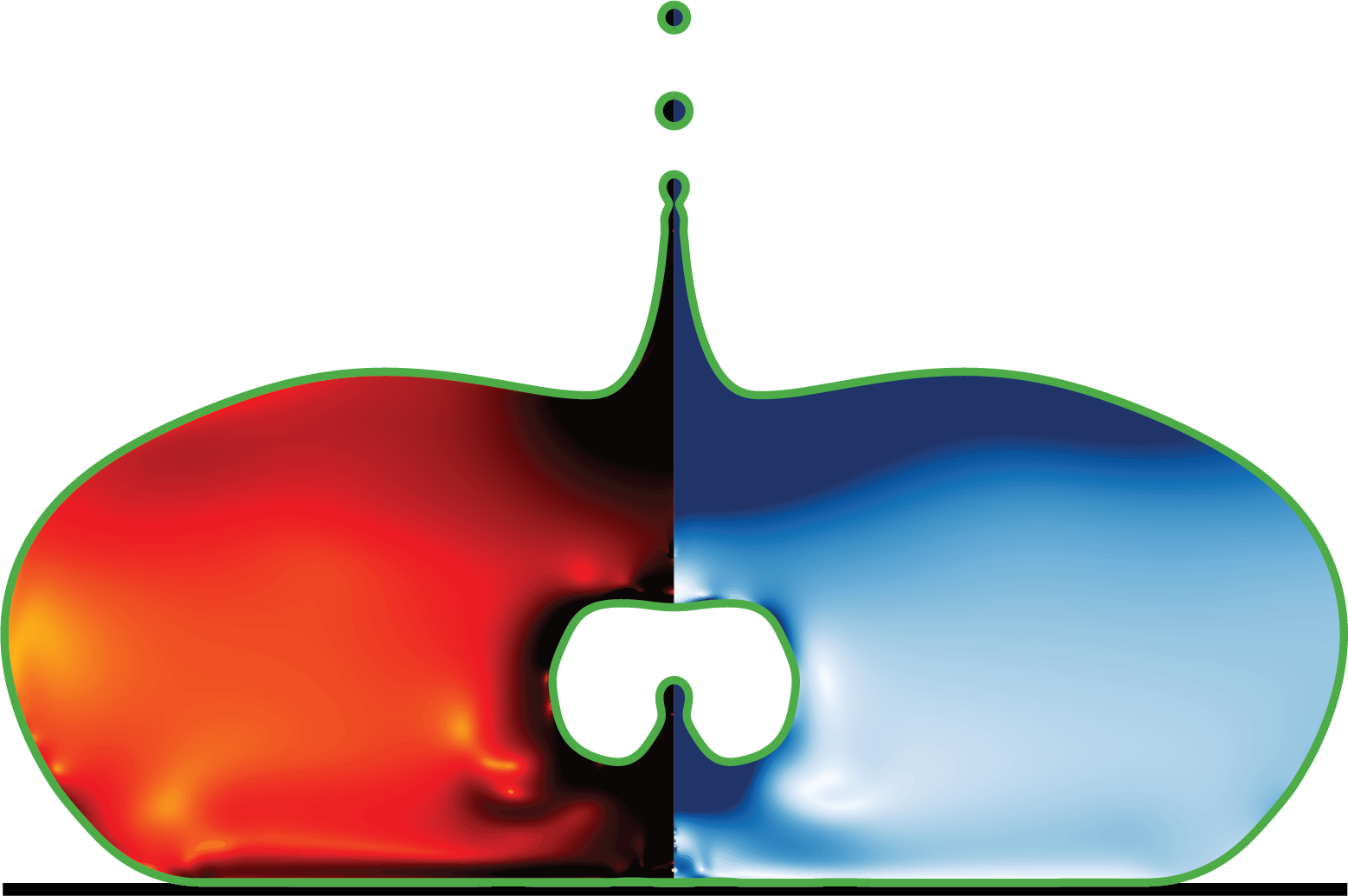
postProcess/getData.c
/* Title: getting Data from simulation snapshot # Author: Vatsal Sanjay # [email protected] # CoMPhy Lab # Durham University # Last updated: Jan 2026
#include “utils.h” #include “output.h”
- Geometry configuration: Set AXI=1 for axisymmetric, AXI=0 for 2D Cartesian.
- Axisymmetric: x=radial, y=axial (includes azimuthal D22 term)
- 2D Cartesian: x=x-coordinate, y=y-coordinate (no D22 term)
- To change geometry:
- Method 1: Edit line 22 below - change “AXI 1” to “AXI 0” for 2D
- Method 2: Compile with flag: qcc -DAXI=0 … (for 2D executable)
#ifndef AXI
#define AXI// Default to axisymmetric
#endif

scalar f[];
vector u[];- Lightweight utility for extracting Basilisk snapshot data on a structured
- Cartesian sampling grid. The workflow is intentionally linear:
- Parse CLI bounds/grid spacing into
extraction_config.
- Parse CLI bounds/grid spacing into
- Restore the snapshot
(
restore(file=...)).
- Restore the snapshot
(
- Register each derived scalar in
field_list.
- Register each derived scalar in
- Compute fields and interpolate them onto a regular grid.
- Stream x, y, <fields…> rows to stderr (used as output pipe).
- To add a new derived quantity (e.g., Aij):
- Declare scalar:
scalar Aij[];(line ~38)
- Declare scalar:
- Register in
register_fields():field_list = list_add(field_list, Aij);
- Register in
- Compute in
compute_fields():compute_Aij_field(Aij);
- Compute in
- Write compute function:
static void compute_Aij_field(scalar target) { ... }
- Write compute function:
typedef struct {
  char filename[4096];
  double xmin, ymin, xmax, ymax;
  double Deltax, Deltay;
  int nx, ny;
} extraction_config;

scalar D2c[], vel[];
scalar * field_list = NULL;

static int parse_arguments(int argc, char const *argv[],
                           extraction_config *cfg);
static int configure_grid(extraction_config *cfg);
static void register_fields(void);
static void compute_fields(void);
static double ** allocate_field_buffer(const extraction_config *cfg,
                                       int field_count);
static void sample_fields(const extraction_config *cfg, double **field_buffer,
                          int field_count);
static void write_fields(const extraction_config *cfg, double **field_buffer,
                         int field_count, FILE *fp);
static void cleanup_output(FILE *fp, double **field_buffer);
static void compute_D2c_field(scalar target);
static void compute_velocity_field(scalar target);- @brief Entry point for simulation snapshot extraction and processing.
- This function validates command-line arguments and orchestrates the simulation
- data restoration, derivative and velocity computations, and interpolation onto
- a grid. It expects the program name followed by exactly six parameters:
- a filename, the lower bounds (xmin and ymin), the upper bounds (xmax and ymax), and
- the number of divisions along the y-axis (ny). If the argument count is incorrect,
- an error message and usage instructions are printed to stderr and the program exits
- with a status of 1.
- @param a The total number of command-line arguments.
- @param arguments Array of command-line argument strings, where arguments[0] is the
- program name and the remaining elements provide the required simulation parameters.
- @return int Exit status of the program (1 on error, 0 on success).
  int main(int a, char const *arguments[])
{
  extraction_config cfg;
  if (!parse_arguments(a, arguments, &cfg))
    return 1;

  if (!configure_grid(&cfg))
    return 1;

  register_fields();
  restore (file = cfg.filename);
  compute_fields();

  int registered_fields = list_len(field_list);
  double ** field =
    allocate_field_buffer(&cfg, registered_fields);
  sample_fields(&cfg, field, registered_fields);

  FILE * fp = ferr;
  write_fields(&cfg, field, registered_fields, fp);
  cleanup_output(fp, field);
}

static int parse_arguments(int argc, char const *argv[],
                           extraction_config *cfg)
{
Read CLI arguments and guard against invalid bounds/grid sizes.
  if (argc != 7) {
    fprintf(stderr, "Error: Expected 6 arguments\n");
    fprintf(stderr,
            "Usage: %s <filename> <xmin> <ymin> "
            "<xmax> <ymax> <ny>\n", argv[0]);
    return 0;
  }

  snprintf(cfg->filename, sizeof(cfg->filename), "%s", argv[1]);
  cfg->xmin = atof(argv[2]);
  cfg->ymin = atof(argv[3]);
  cfg->xmax = atof(argv[4]);
  cfg->ymax = atof(argv[5]);
  cfg->ny = atoi(argv[6]);

  if (cfg->ny <= 0) {
    fprintf(stderr, "Error: ny must be positive.\n");
    return 0;
  }

  if (cfg->xmax <= cfg->xmin || cfg->ymax <= cfg->ymin) {
    fprintf(stderr, "Error: Bounds must satisfy xmax>xmin "
                    "and ymax>ymin.\n");
    return 0;
  }

  return 1;
}

static int configure_grid(extraction_config *cfg)
{
Translate bounds and ny into nx, Δx, Δy for regular sampling.
  cfg->Deltay = (cfg->ymax - cfg->ymin)/((double) cfg->ny);
  cfg->nx = (int) ((cfg->xmax - cfg->xmin)/cfg->Deltay);

  if (cfg->nx <= 0) {
    fprintf(stderr, "Error: Computed nx <= 0. "
                    "Check the provided bounds.\n");
    return 0;
  }

  cfg->Deltax = (cfg->xmax - cfg->xmin)/((double) cfg->nx);
  return 1;
}

static void register_fields(void)
{- Populate Basilisk list with each scalar field.
- To add a new field, declare the scalar at the top and add it here.
  field_list = list_add(field_list, D2c);
  field_list = list_add(field_list, vel);
}

static void compute_fields(void)
{- Dispatch compute callbacks for each field.
- To add a new field, add a compute call here.
  compute_D2c_field(D2c);
  compute_velocity_field(vel);
}

static double ** allocate_field_buffer(const extraction_config *cfg,
                                       int registered_fields)
{
  return (double **) matrix_new (cfg->nx, cfg->ny + 1,
                                 registered_fields*sizeof(double));
}

static void sample_fields(const extraction_config *cfg, double **field_buffer,
                          int registered_fields)
{- Interpolate every registered scalar on the regular grid that we later dump.
- The matrix layout follows Basilisk’s
matrix_new: row-major on i (x), - with contiguous blocks of
registered_fieldsentries per (i, j).
  for (int i = 0; i < cfg->nx; i++) {
    double x = cfg->Deltax*(i + 1./2) + cfg->xmin;
    for (int j = 0; j < cfg->ny; j++) {
      double y = cfg->Deltay*(j + 1./2) + cfg->ymin;
      int k = 0;
      for (scalar s in field_list)
        field_buffer[i][registered_fields*j + k++] =
          interpolate (s, x, y);
    }
  }
}

static void write_fields(const extraction_config *cfg, double **field_buffer,
                         int registered_fields, FILE *fp)
{
Stream rows in the format: x y field0 field1 …
  for (int i = 0; i < cfg->nx; i++) {
    double x = cfg->Deltax*(i + 1./2) + cfg->xmin;
    for (int j = 0; j < cfg->ny; j++) {
      double y = cfg->Deltay*(j + 1./2) + cfg->ymin;
      fprintf (fp, "%g %g", x, y);
      int k = 0;
      for (scalar s in field_list)
        fprintf (fp, " %g",
                 field_buffer[i][registered_fields*j + k++]);
      fputc ('\n', fp);
    }
  }
}

static void cleanup_output(FILE *fp, double **field_buffer)
{
  fflush (fp);
  fclose (fp);
  matrix_free (field_buffer);
}- @brief Compute log10(D²) where D² is the second invariant of the strain
- rate tensor.
- Geometry-dependent formulation:
- Axisymmetric (AXI=1, x=radial, y=axial):
- D11 = ∂u_y/∂y (axial velocity gradient)
- D22 = u_y/y (azimuthal component from cylindrical geometry)
- D33 = ∂u_x/∂x (radial velocity gradient)
- D13 = (∂u_y/∂x + ∂u_x/∂y)/2 (shear component)
- D² = D11² + D22² + D33² + 2*D13²
- 2D Cartesian (AXI=0, x and y coordinates):
- D11 = ∂u_y/∂y
- D33 = ∂u_x/∂x
- D13 = (∂u_y/∂x + ∂u_x/∂y)/2
- D² = D11² + D33² + 2*D13² (no D22 term)
- Returns log10(D²) for positive values, -10 otherwise (floor for
- visualization). Shown throughout the entire domain.
static void compute_D2c_field(scalar target)
{
  foreach() {
    double D11 = (u.y[0,1] - u.y[0,-1])/(2*Delta);
#if AXI
    double D22 = (y > 1e-10) ? u.y[]/y : 0.0;  // Epsilon guard for axis
#endif
    double D33 = (u.x[1,0] - u.x[-1,0])/(2*Delta);
    double D13 =
      0.5*((u.y[1,0] - u.y[-1,0] + u.x[0,1] - u.x[0,-1])/(2*Delta));
#if AXI
    double D2 = sq(D11) + sq(D22) + sq(D33) + 2.*sq(D13);
#else
    double D2 = sq(D11) + sq(D33) + 2.*sq(D13);
#endif
    target[] = D2;
    if (target[] > 0.)
      target[] = log(target[])/log(10);
    else
      target[] = -10;
  }
}- @brief Compute velocity magnitude.
- Geometry-independent calculation:
- Axisymmetric (AXI=1): u.x=radial, u.y=axial
- 2D Cartesian (AXI=0): u.x=x-component, u.y=y-component
- Returns |u| = sqrt(u_x² + u_y²).
static void compute_velocity_field(scalar target)
{
  foreach()
    target[] = sqrt(sq(u.x[]) + sq(u.y[]));
}