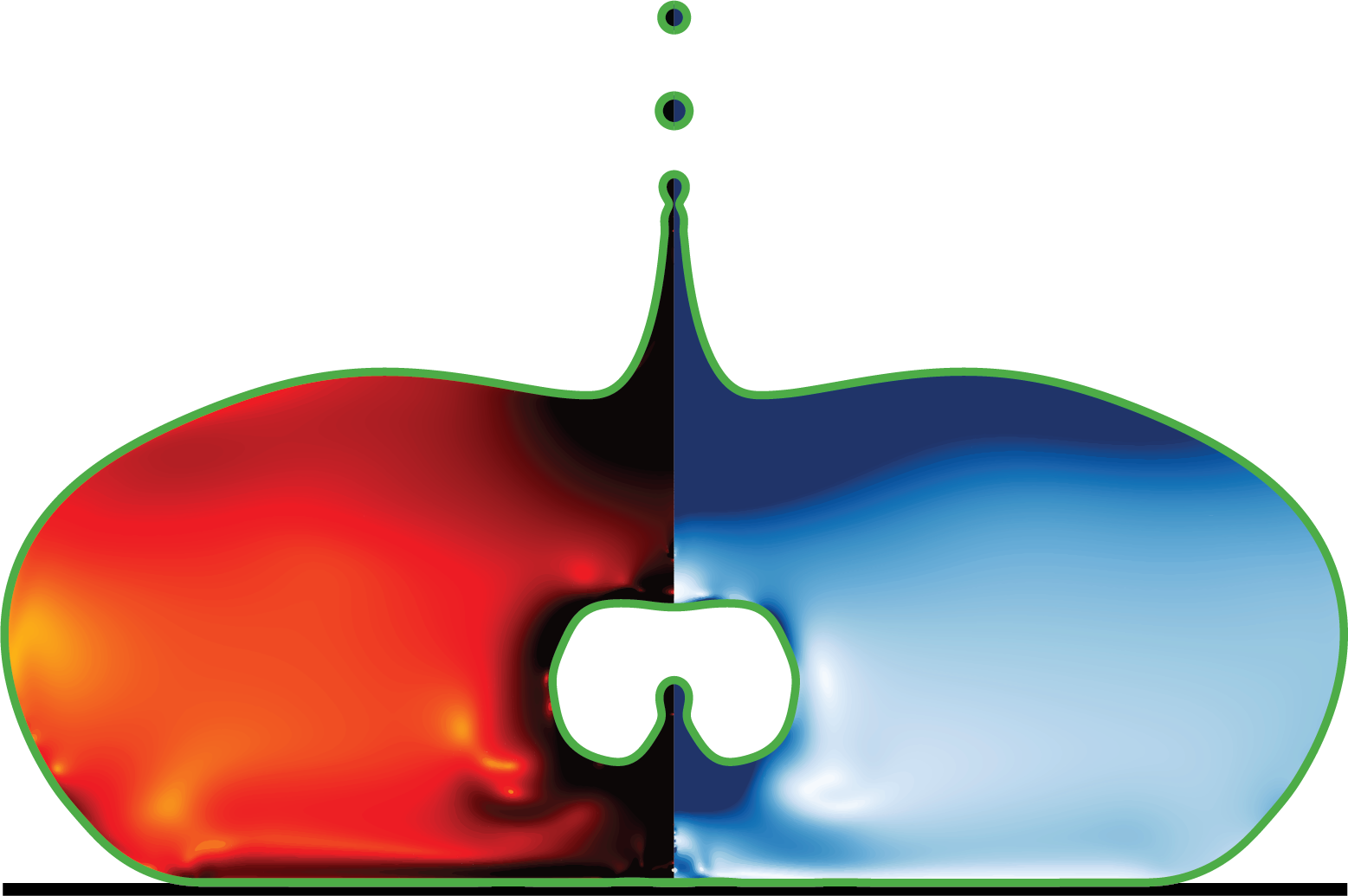
postProcess/getData.c
getData.c
Sample velocity magnitude and viscous dissipation
from a bretherton.c snapshot onto a uniform
grid, for rendering.
The dispersed phase is f = 1 and the
continuous wetting phase is f = 0 (see
simulationCases/bretherton.c), so the local
viscosity is \(\mu(f) = f\mu_R
+ (1-f)\) in units of \(\mu_c\). This is the
opposite assignment to the bursting-bubble
post-processors, where the liquid carries
f = 1; taking their mapping unchanged would
paint the bubble interior with the continuous-phase
viscosity and overstate dissipation inside it by two
orders of magnitude.
The tube wall is an embedded boundary, so cells
inside the solid carry no meaningful velocity.
cs is emitted alongside the fields and the
renderer masks on it; nothing here guesses a value for
the solid.
Usage
./getData <dump> <xmin> <ymin> <xmax> <ymax> <ny> <muR>Columns on stderr:
x y cs f log10(mu D:D) |u| u_x.
u_x is the axial component. The mean of
|u| inside a bubble exceeds its translation
speed whenever the interior recirculates, so a
plug-velocity check must use u_x, not the
magnitude.
Dissipation is reported as \(\log_{10}(\mu\,\mathbf{D}\!:\!\mathbf{D})\), matching the sibling convention; the true viscous dissipation rate is \(2\mu\,\mathbf{D}\!:\!\mathbf{D}\), so this is a constant \(\log_{10}2\) below it and the colourbar is labelled accordingly.
#include <errno.h>
#include <math.h>

#include "utils.h"
#include "output.h"

scalar f[], cs[];
vector u[];
scalar D2c[], vel[], ux[];

int main (int argc, char const *argv[])
{
  if (argc < 8) {
    fprintf (ferr, "usage: %s <dump> <xmin> <ymin> <xmax> <ymax> <ny> <muR>\n",
             argv[0]);
    return 1;
  }
  char filename[4096];
  snprintf (filename, sizeof(filename), "%s", argv[1]);
atof cannot distinguish “0” from
unparseable text, so a mistyped viscosity ratio would
silently become zero and paint the whole field with the
continuous-phase viscosity.
  double val[6];
  const char * names[6] = {"xmin", "ymin", "xmax", "ymax", "ny", "muR"};
  for (int k = 0; k < 6; k++) {
    char * end = NULL;
    errno = 0;
    val[k] = strtod (argv[k+2], &end);
    if (end == argv[k+2] || *end != '\0' || errno == ERANGE ||
        !isfinite (val[k])) {
      fprintf (ferr, "ERROR: %s is not a finite number: '%s'\n",
               names[k], argv[k+2]);
      return 1;
    }
  }
  double xmin = val[0], ymin = val[1], xmax = val[2], ymax = val[3];
ny arrives as a double, and casting a
fractional or very large double to int is
undefined behaviour, so bound it before the conversion
rather than after.
  if (val[4] != floor (val[4]) || val[4] < 2. || val[4] > 100000.) {
    fprintf (ferr, "ERROR: ny must be a whole number in [2, 100000], got %g\n",
             val[4]);
    return 1;
  }
  int ny = (int) val[4];
  double muR = val[5];
  if (muR <= 0.) {
    fprintf (ferr, "ERROR: muR must be positive, got %g\n", muR);
    return 1;
  }

  /* ny and nx index a spacing of (max-min)/(n-1), so a single sample
     would divide by zero. */
  if (ny < 2 || xmax <= xmin || ymax <= ymin) {
    fprintf (ferr, "ERROR: need xmax>xmin, ymax>ymin and ny>=2\n");
    return 1;
  }
A missing or unreadable dump leaves the fields at their defaults, and sampling them would emit a plausible-looking grid of zeros.
  if (!restore (file = filename)) {
    fprintf (ferr, "ERROR: cannot restore snapshot '%s'\n", filename);
    return 1;
  }
Axisymmetric strain-rate invariant. D22
is the hoop term \(u_y/y\), guarded on the
axis.
  foreach() {
    double D11 = (u.y[0,1] - u.y[0,-1])/(2.*Delta);
The hoop strain rate is \(u_r/r\). On the axis \(u_r \to 0\) linearly, so
the limit is \(\partial
u_r/\partial r\), which is D11;
taking zero there would drop a real contribution to
\(\mathbf{D}:\mathbf{D}\).
    double D22 = (y > 1e-10) ? u.y[]/y : D11;
    double D33 = (u.x[1,0] - u.x[-1,0])/(2.*Delta);
    double D13 = 0.5*((u.y[1,0] - u.y[-1,0] + u.x[0,1] - u.x[0,-1])/(2.*Delta));
    double D2 = sq(D11) + sq(D22) + sq(D33) + 2.*sq(D13);
    double muLocal = clamp(f[],0.,1.)*muR + (1. - clamp(f[],0.,1.));
    double diss = muLocal*D2;
    D2c[] = diss > 0. ? log(diss)/log(10.) : -10.;
    vel[] = sqrt (sq(u.x[]) + sq(u.y[]));
    ux[] = u.x[];
  }
interpolate() reads neighbours,
including ghosts. Without this the ghosts keep their
default zero and samples near the axis and the domain
edges are pulled towards it.
  boundary ({D2c, vel, ux});

  double Deltay = (ymax - ymin)/(ny - 1);
  double nxd = (xmax - xmin)/Deltay + 1.;
  if (!(nxd >= 2. && nxd <= 100000.)) {
    fprintf (ferr, "ERROR: computed nx = %g is outside [2, 100000]; "
             "adjust the x range or ny\n", nxd);
    return 1;
  }
  int nx = (int) nxd;
  if (nx < 2) {
    fprintf (ferr, "ERROR: computed nx < 2; widen the x range or raise ny\n");
    return 1;
  }
  double Deltax = (xmax - xmin)/(nx - 1);

  for (int i = 0; i < nx; i++) {
    double xp = xmin + i*Deltax;
    for (int j = 0; j < ny; j++) {
      double yp = ymin + j*Deltay;
interpolate() returns
nodata outside the domain and inside the
embedded solid. Emitting that sentinel as a number would
let a renderer plot 1e30 as a real value, so it becomes
nan here and the renderer masks on it.
      double vcs = interpolate (cs, xp, yp);
      double vf  = interpolate (f, xp, yp);
      double vd  = interpolate (D2c, xp, yp);
      double vu  = interpolate (vel, xp, yp);
      double vax = interpolate (ux, xp, yp);
      fprintf (ferr, "%g %g %g %g %g %g %g\n", xp, yp,
               vcs > 0.5*nodata ? nan("") : vcs,
               vf  > 0.5*nodata ? nan("") : vf,
               vd  > 0.5*nodata ? nan("") : vd,
               vu  > 0.5*nodata ? nan("") : vu,
               fabs(vax) > 0.5*nodata ? nan("") : vax);
    }
  }
  return 0;
}