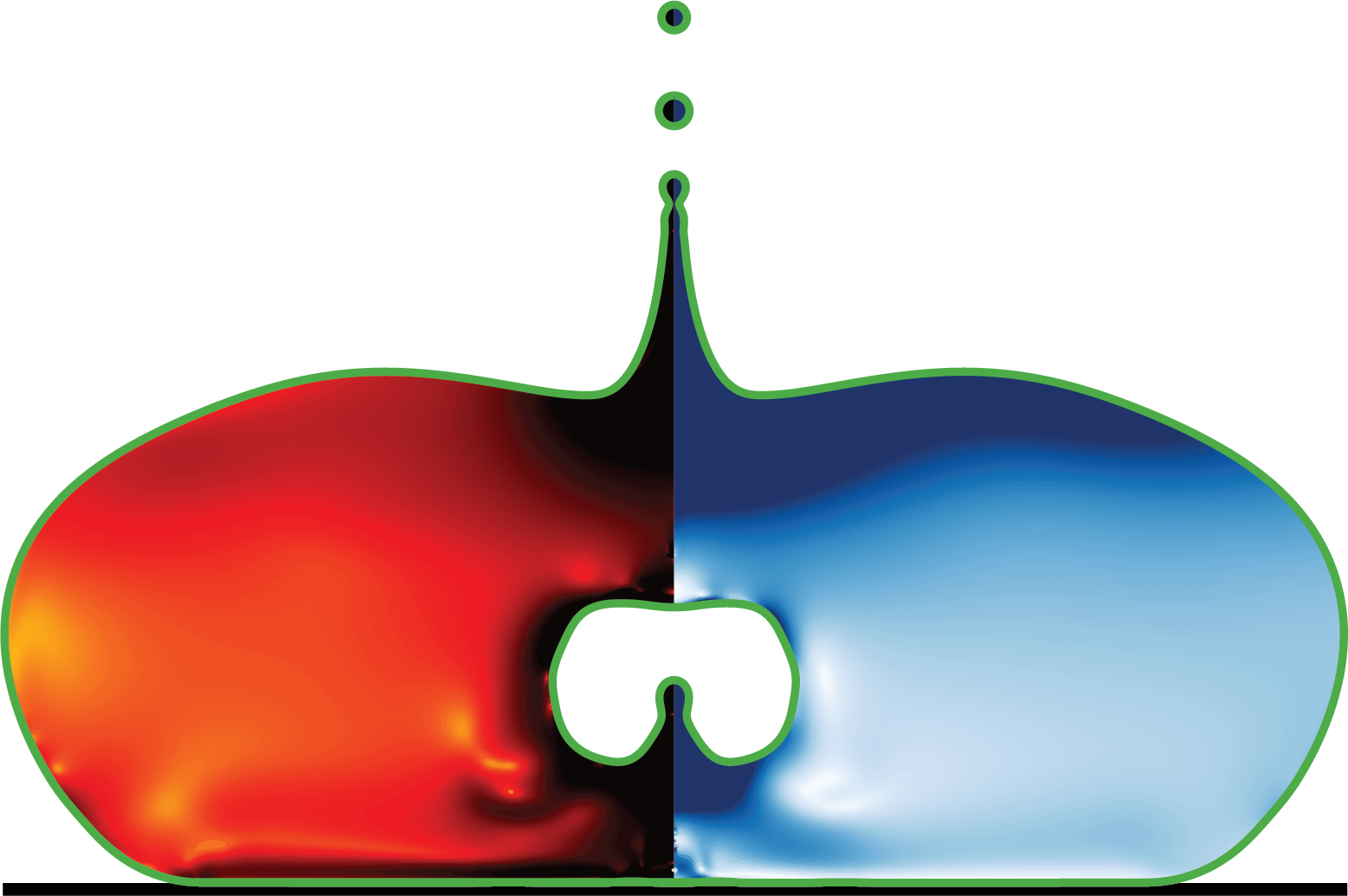
simulationCases/soapBubble-half.c
Axisymmetric Bubble Wrinkling Simulation
Overview
This simulation models the dynamics of a thin liquid film forming a bubble with wrinkling instabilities. The code solves the two-phase Navier-Stokes equations in an axisymmetric configuration, capturing the interface dynamics between a liquid film and surrounding gas phase.
Physics Description
The simulation captures: - Two-phase flow dynamics with surface tension effects - Gravitational forcing characterized by Bond number (Bo) - Viscous effects characterized by Ohnesorge number (Oh) - Interface tracking using Volume-of-Fluid (VOF) method - Adaptive mesh refinement for efficient computation
Authors and Changelog
- Author: Saumili Jana ([email protected])
- Created: October 18, 2024
Version History
- Oct 28, 2024 (Vatsal): Fixed initial condition implementation
- Mar 6, 2025 (Saumili): Corrected boundary condition formulation
- Mar 15, 2025 (Saumili): Updated pressure boundary conditions
- Mar 31, 2025 (Saumili): Increased iterations for convergence
- Apr 4, 2025 (Saumili): Corrected pressure initial condition
Phase Convention
- f = 1: Liquid phase (thin film)
- f = 0: Gas phase (surrounding medium)
#include "axi.h"
#include "navier-stokes/centered.h"
#include "two-phase.h"
#include "navier-stokes/conserving.h"
#include "tension.h"
#include "henry.h"

scalar T[], * stracers = {T};
Simulation Parameters
Adaptive Mesh Refinement Tolerances
These control the error thresholds for grid adaptation: - Volume fraction error tolerance - Velocity component error tolerance - Curvature error tolerance - Acceleration error tolerance
#define fErr (1e-3)
52
#define VelErr (1e-3)
53
#define KErr (1e-3)
54
#define AErr (1e-3)
55
#define MINlevel 2
56
57
Time Control Parameters
tsnap: Interval for saving simulation snapshots
#define tsnap (0.01)
62
63
Physical Properties
Rho21: Density ratio between gas and liquid phases (\(\rho_g/\rho_l\))Mu21: Viscosity ratio between gas and liquid phases (\(\mu_g/\mu_l\))Xcent,Ycent: Center coordinates of the bubbleR2circle: Macro for computing squared radial distance
#define Rho21 (1e-3)
71
#define Mu21 (1e-3)
72
#define Xcent (0.0)
74
#define Ycent (0.0)
75
#define R2circle(x,y) (sq(x - Xcent) + sq(y - Ycent))
76
77
Boundary Conditions
Left Boundary (Axis of Symmetry)
- No-slip wall condition for velocity
- Contact angle set to 90 degrees via Dirichlet condition on f
u.t[left] = dirichlet(0.0);
u.n[left] = dirichlet(0.0);
f[left] = dirichlet(0.0);
Right Boundary (Outflow)
- Neumann conditions for velocity components
- Dirichlet condition for pressure (atmospheric)
u.t[right] = neumann(0.0);
u.n[right] = neumann(0.0);
p[right] = dirichlet(0.0);
Top Boundary (Outflow)
- Neumann conditions for velocity components
- Dirichlet condition for pressure (atmospheric)
u.t[top] = neumann(0.0);
u.n[top] = neumann(0.0);
p[top] = dirichlet(0.0);
Global Variables
MAXlevel: Maximum refinement level for adaptive meshtmax: Maximum simulation timeOh1: Ohnesorge number for liquid filmBo: Bond number (gravity/surface tension ratio)Ldomain: Domain sizek: Curvature parameter (R/h ratio)h: Film thickness
int MAXlevel;
double tmax, Oh1, Pe_gas, Ldomain, k, h;
Main Function
Purpose
Initializes simulation parameters and launches the computation.
Key Parameters Set
- Maximum grid refinement level: 8
- Simulation duration: 1.0 time units
- Domain size: 2.4 units
- Ohnesorge number: 0.01 (moderate viscous effects)
- Curvature parameter: 10 (thin film approximation)
int main(int argc, char const *argv[]) {
  // Parameter assignments
  MAXlevel = 11;
  tmax = 1.0;
  Ldomain = 5.0;

  Oh1 = 1e-3;
  k = 2.5e1;
Note on the Peclet number: Peclet number based on diffusion coefficient of smoke in air. \[ Pe = \frac{V_\gamma R_0}{D} \] The inertio-capillary velocity is usuallly 0.1-1 m/s. Typical bubble radius is 1 mm. The diffusion coefficient of smoke in air is 1e-4 to 1e-5 m^2/s.
  Pe_gas = 1e-1;

  fprintf(ferr, "Level %d, tmax %g, Oh1 %3.2e, Lo %g\n",
          MAXlevel, tmax, Oh1, Ldomain);

  // Domain configuration
  L0 = Ldomain;
  init_grid(1 << 6);

  // Create output directory
  char comm[80];
  sprintf(comm, "mkdir -p intermediate");
  system(comm);

  // Physical properties assignment
  rho1 = 1.0; rho2 = Rho21;
  mu1 = Oh1; mu2 = Mu21*Oh1;
  f.sigma = 1.0;  // Surface tension coefficient

  // for smoke concentration T
  T.D1 = 1e-3/Pe_gas; // inverse Peclet number based on diffusion coefficient of smoke in water, $Pe_\text{water} \to \infty$.
  T.D2 = 1e0/Pe_gas; // inverse Peclet number based on diffusion coefficient of smoke in air.
  T.alpha = 1e-3; // proportion of smoke in water right at the interface (this should be close to 0.).

  run();
}
Initial Condition Event
Purpose
Sets up the initial bubble geometry with a half-circle lower part and spherical rim upper part. This creates a bubble with controlled wrinkling potential based on the curvature parameter k.
Geometry Construction
- Lower region: Half-circular cap
- Upper region: Spherical shell rim
- Film thickness: h = 1/k
- Initial refinement focused near the interface
event init(t = 0) {
  if (!restore(file = "dump")) {
    float y_p, x_p, x1, x2;
    h = 1/k;
    y_p = 0.1;
    x1 = sqrt(sq(1.0 - h) - sq(y_p));
    x2 = sqrt(1 - sq(y_p));
    x_p = (x1 + x2) / 2;

    // Adaptive refinement near interface
    refine((R2circle(x, y) < 1.05) &&
           (R2circle(x, y) > sq(0.025*(1.0 - h))) &&
           (level < MAXlevel));

    // Initialize level-set function for interface
    vertex scalar phi[];
    foreach_vertex() {
      if (y < y_p && x > 0.0) {
        // Lower part - half circle geometry
        phi[] = (sq(h/2) - (sq(x - x_p) + sq(y - y_p)));
      } else {
        // Upper part - spherical rim
        double r = sqrt(sq(x) + sq(y));
        double shell = min(1. - r, (r - (1. - h)));
        phi[] = shell;
      }
    }
    fractions(phi, f);
    fraction(T, (sq((1.0 - h)*0.5) - R2circle(x, y)));

    // Initialize pressure field based on region
    foreach() {
      T[] *= 1e1;
      if (R2circle(x, y) < sq(1.0 - h)) {
        p[] = 2. + 2./(1.-h);  // Inner bubble pressure
      }
      else if ((R2circle(x, y) <= 1) &&
               (R2circle(x, y) >= sq(1.0 - h))) {
        p[] = 2*f[];  // Film pressure
      }
      else {
        p[] = 0;  // Atmospheric pressure
      }
      u.x[] = 0;
      u.y[] = 0;
    }
  }
}
Adaptive Mesh Refinement Event
Purpose
Dynamically refines the computational mesh based on solution gradients. This ensures high resolution near the interface and regions of high curvature while maintaining efficiency in smooth regions.
Refinement Criteria
- Volume fraction gradients (interface tracking)
- Velocity component gradients (flow features)
- Curvature gradients (wrinkling detection)
scalar KAPPA[];
event adapt(i++) {
  curvature(f, KAPPA);
  adapt_wavelet((scalar *){f, u.x, u.y, KAPPA},
                (double[]){fErr, VelErr, VelErr, KErr},
                MAXlevel, MAXlevel - 4);
}
Data Output Event
Purpose
Saves simulation state at regular intervals for post-processing and restart capability.
Output Schedule
- Initial condition saved at t = 0
- Snapshots saved every tsnap time units
- Full field data including pressure dumped
event writingFiles(t = 0, t += tsnap; t <= tmax) {
  p.nodump = false;  // Enable pressure output
  dump(file = "dump");

  char nameOut[80];
  sprintf(nameOut, "intermediate/snapshot-%5.4f", t);
  dump(file = nameOut);
}
Logging Event
Purpose
Maintains a detailed log of simulation progress including timestep information and key parameters.
Log Contents
- Iteration number
- Current timestep size
- Simulation time
- Initial header with all simulation parameters
event logWriting(i++) {
  static FILE * fp;
  if (pid() == 0) {
    if (i == 0) {
      fprintf(ferr, "i dt t\n");
      fp = fopen("log", "w");
      fprintf(fp, "Level %d, tmax %g, Oh %3.2e, Lo %g\n",
              MAXlevel, tmax, Oh1, Ldomain);
      fprintf(fp, "i dt t\n");
      fprintf(fp, "%d %g %g \n", i, dt, t);
      fclose(fp);
    } else {
      fp = fopen("log", "a");
      fprintf(fp, "%d %g %g\n", i, dt, t);
      fclose(fp);
    }
    fprintf(ferr, "%d %g %g\n", i, dt, t);
  }
}