ActiveDrops
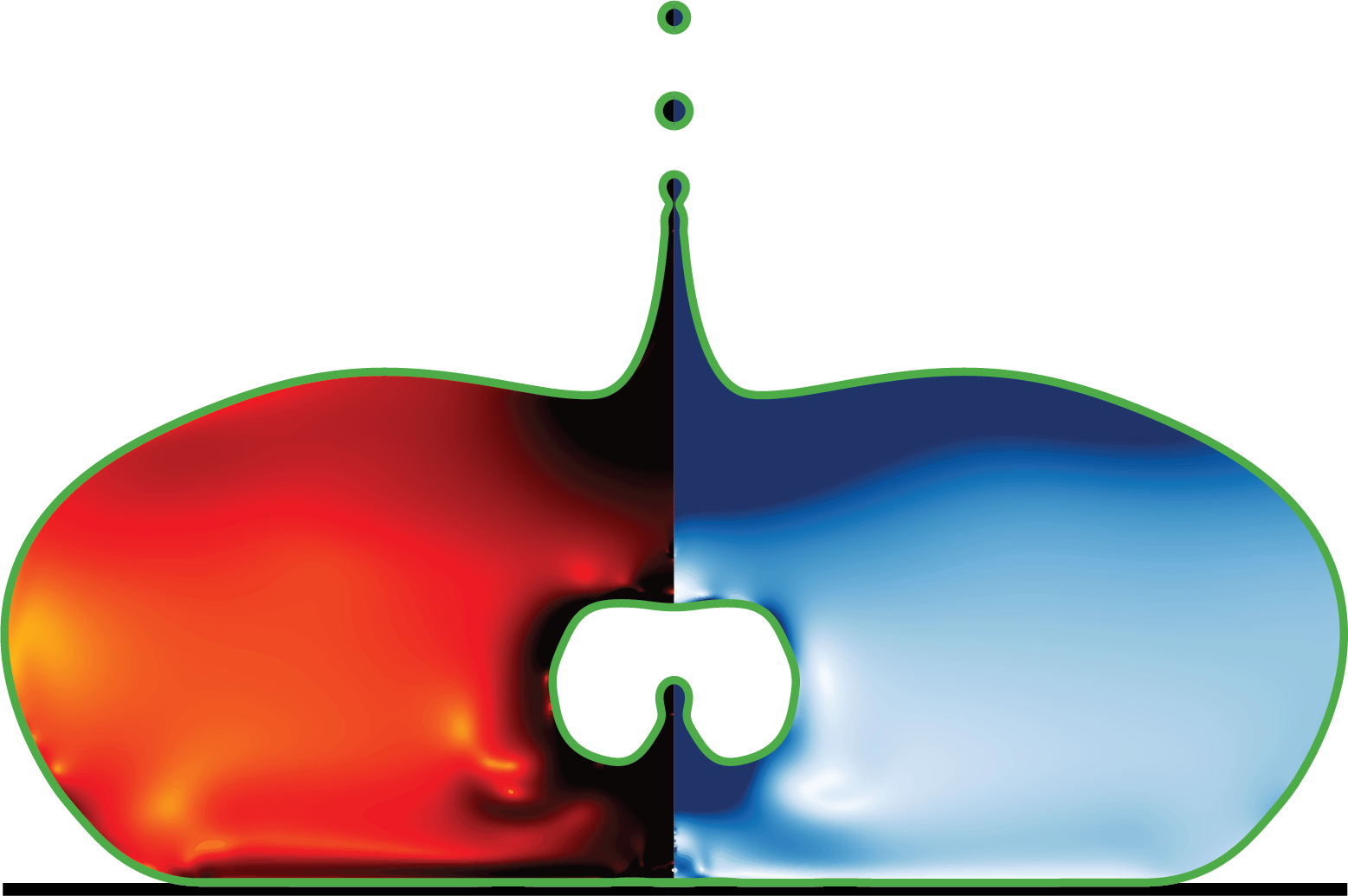
Spontaneous symmetry breaking of self-propelled drops.
A planar drop emits a chemical species at its
interface. The species diffuses and is advected in the
outer phase. The implemented constitutive law is
sigma = 1/Ca + 4*cL: positive concentration
increases surface tension. Above a critical Péclet
number the isotropic state is unstable: a small
asymmetry in the concentration field drives a Marangoni
flow that reinforces the asymmetry, and the drop
self-propels. The code integrates this problem in the
Stokes limit with Basilisk using the coupled
level-set and volume-of-fluid (CLSVOF) interface method
and the integral formulation of surface tension, and
provides a bracketed search for the finite-time onset in
Pe.
Layout
- basilisk/ - - Project-local pinned Basilisk (ignored; installed by the script below)
- simulationCases/ - -
Simulation entry point and generated case folders
- dropMove.c - - Unconfined planar reference in a finite box
- dropMove-embed-pipe.c - - Axisymmetric drop in a straight embedded pipe
- dropMove-embed-channel.c - - Planar drop between embedded walls
- src-local/
- - Project-specific Basilisk headers and the runtime
parameter API
- activity.h - - Interfacial chemical source and species transport
- parse_params.h - - Low-level key/value parser for parameter files
- params.h - - Typed parameter accessors (param_int, param_double, …)
- two-phase-clsvof-VP.h - - Experimental viscoplastic CLSVOF variant (not used by dropMove.c)
- postProcess/ - -
Snapshot readers and plotting scripts
- getCM.c - - Volume-weighted drop centroid of a snapshot
- getData.c - - Concentration, deformation-rate norm and speed on a grid
- getDataSlice.c - - Volume fraction and velocity on a grid
- getFacets.c - - Interface segments
- getVelocity_v2.c - - Drop velocity of a snapshot
- contour.py - - Parallel per-snapshot panels (concentration, deformation rate, speed)
- vectors.py - - Legacy serial velocity-vector frames
- testCases/
- - Software tests
- test_pescan.py - - Synthetic-classifier tests for PeScan.py
- centroid-check.c - - Centroid diagnostic on an asymmetric adaptive mesh
- run-tests.sh - - Runs both
- .github/ - - Documentation generator, workflows, issue templates and the generated site
- runSimulation.sh - - Single-case compile/run driver
- runParameterSweep.sh - - Parameter sweep driver
- PeScan.py - - Bracketed onset search in Pe (calls runSimulation.sh per sample)
- default.params - - Base runtime parameters
- sweep.params - - Example sweep definition
- AGENTS.md - - Repository conventions and evidence classes
- LICENSE - - GPL-3.0
- README.md - - This file
Requirements
- A C compiler,
make,gawkandcurlfor the Basilisk install. - Python 3 for
PeScan.pyand the tests (standard library only). - Python 3 with
numpy,pandasandmatplotlibforpostProcess/*.py.
Basilisk is pinned per project. From the repository root:
curl -fsSL https://raw.githubusercontent.com/comphy-lab/basilisk-C/v2026-08-30/reset_install_basilisk-ref-locked.sh | bash -s -- --ref=v2026-08-30
source .project_config
This installs the selected comphy-lab/basilisk-C
release into basilisk/, records the ref in
basilisk/.comphy-lock and writes
.project_config, which the runners source.
Both paths are ignored by Git. The code was last built
and run against release v2026-08-30; it
requires a release of August 2026 or later
(FILTERED defined with a value, comma-free
reductions, no dirty attribute).
Single case
bash runSimulation.sh default.paramsThe runner creates
simulationCases/c<CaseNo>/, copies
the parameter and source files there, compiles with
-I../../src-local and runs
./dropMove case.params. Snapshots go to
intermediate/snapshot-<t> and
diagnostics to log.dat with columns
i t ke dist xcm ycm volume. The run prints
exactly one STATUS line
(MOVED, NOT_MOVED or
FAILED) and one
SUMMARY key=value line. Use
--threads N for an OpenMP build and
--exec to select another source in
simulationCases/.
Parameter file keys
dropMove.c reads these keys (defaults in
brackets):
CaseNo[1000], must be at least 1000 so case folders sort.Pe[1.6]: Péclet number, species diffusivity1/Pe.MAXlevel[8],MINlevel[0]: quadtree refinement bounds.Oh[1],Ca[0.1],AcNum[1]: density4/Oh^2, clean surface tension1/Ca, interfacial chemical flux.L0[10]: square domain size in drop radii; walls are no-slip with zero concentration.tmax[50],tsnap[0.1]: observation horizon and snapshot interval.threshold[1]: centroid displacement in drop radii classified asMOVED; a value of zero or less disables the early stop.FErr,VelErr,cErr,KErr[1e-3]: wavelet adaptation tolerances.keLimit[1e3]: kinetic energy classified asFAILED.
Embedded confinement cases
bash runSimulation.sh embed-pipe.params --exec dropMove-embed-pipe.c
bash runSimulation.sh embed-channel.params --exec dropMove-embed-channel.c
wallHalfWidth is the pipe radius or
channel half-width, in initial drop radii (default
2.53). A wall exactly aligned with
finest-grid faces is rejected because it has no cut-cell
fragment for the embedded no-slip flux. The pipe starts
a unit sphere on the axis (y=0) and cannot
represent transverse migration. The channel starts a
planar unit circle at (0,dropOffset); its
default offset is 0.5.
initialDipole seeds an axial concentration
asymmetry and may be set to zero. Both example files
disable the displacement early stop with
threshold=0.
The embedded sidewalls are no-slip and impermeable to
species: cL[embed] = neumann(0). The axial
endcaps are no-slip with cL=0, so the
finite end distance remains a model parameter. Activity
adds the source AcNum*|grad(f)| at the drop
interface; it does not create wall flux. Here
cL is produced species, not directly a
consumed-fuel concentration. Absorbing, reactive or
fixed-fuel walls would require a different chemical
boundary model.
These cases require the pinned Basilisk
v2026-08-30 and reconstruct the stationary
embedded geometry after mesh adaptation. No
contact-angle or wetting model is supplied: a
liquid-containing cell entering a three-finest-cell
wall/endcap band stops with FAILED. In the
pipe, volume and ke omit the
common 2*pi factor; ycm is the
mean radius, and dist measures axial
displacement. Existing planar post-processing readers
must not be used to infer pipe volume or transverse
motion.
Software checks for geometry and species wall
conditions are available via
bash testCases/run-embed-tests.sh. These
are implementation checks; convergence and physical wall
attraction or repulsion require separate study.
Parameter sweep
bash runParameterSweep.sh sweep.params --dry-run
bash runParameterSweep.sh sweep.params --parallel 2
SWEEP_* lists in the sweep file form a
Cartesian product; each case gets a deterministic
CaseNo from CASE_START. Set
CASE_END to assert the expected number of
cases.
Onset scan
python3 PeScan.py 1.0 0.5 --tmax 50 --max-level 9 --tol 0.005 --tag level9PeScan.py runs one case per sample
through runSimulation.sh (case numbers from
--case-start, default 2000), first
bracketing the transition with one stationary and one
moving endpoint, then bisecting until the bracket is
narrower than --tol, then taking one
verification sample on each side. Results, including
every sampled run and the classification convention, are
written to
simulationCases/pescan-<tag>/results.json.
Outcomes are:
bracketed: interval[pe_lo, pe_hi]withpe_lostationary andpe_himoving;undetermined: no bracket inside[--pe-min, --pe-max](all runs moved, or none did withintmax);failed: a run stopped on a numerical failure and is not classifiable;nonmonotone: a verification sample contradicts a single threshold.
The exit status is 0 only for a bracket converged to tolerance.
Diagnostics and classification convention
The drop centroid, drop volume and kinetic energy are
integrated with the cell volume, f*dv(). On
the adaptive mesh the cell count is not a measure of
area, so a count-weighted centroid is biased towards
refined regions; testCases/centroid-check.c
places a circle on a mesh whose right half is refined
two levels deeper and shows a count-weighted centroid
error of about two coarse cells against below one
percent of a coarse cell for the volume-weighted
centroid. Displacement is measured from the centroid at
the first step.
MOVED means the centroid moved by more
than threshold before tmax.
This is a finite-time, finite-displacement convention:
near onset the displacement grows slowly and can be
censored by the observation window, so a reported
interval depends on tmax,
threshold and MAXlevel, all of
which are recorded in every SUMMARY line
and in results.json. Near the transition,
lengthen tmax, lower threshold
and increase MAXlevel until the interval
stops moving, and inspect the growth of
dist in log.dat before quoting
a value.
Tests
bash testCases/run-tests.shBoth tests are software tests: the first exercises
the scan logic with synthetic classifiers (monotone
threshold, all moving, all stationary, non-monotone
window, numerical failure, run cap); the second checks
the centroid diagnostic against the exact centroid of a
circle on an asymmetrically refined quadtree and needs
qcc. Neither is a verification of
convergence nor a validation against independent data;
no such case exists in this repository yet.
Post-processing
cd postProcess
python3 contour.py --caseToProcess ../simulationCases/c1000 --tSnap 0.1 --cpus 4
contour.py compiles
getFacets and getData once
with qcc, then renders one frame per
snapshot in parallel (--cpus, alias
--CPUs; --max-frames bounds
the number of snapshots). vectors.py is a
legacy serial script with hard-coded paths kept for
reference. The readers compile individually with
qcc -O2 -Wall -disable-dimensions getCM.c -o getCM -lm
./getCM ../simulationCases/c1000/intermediate/snapshot-10.0000
Documentation site
bash .github/scripts/build.sh
bash .github/scripts/deploy.sh
The generator renders the literate C and Python
sources under src-local/,
simulationCases/, postProcess/
and testCases/ into
.github/docs/, which is committed; the
GitHub Pages workflow deploys it from
main.
Licence
GPL-3.0; see LICENSE.
Generated Documentation
Root Directory
- PeScan.py
- default.params
- embed-channel.params
- embed-pipe.params
- runParameterSweep.sh
- runSimulation.sh
- sweep.params
postProcess
- postProcess/contour.py
- postProcess/getCM.c
- postProcess/getData.c
- postProcess/getDataSlice.c
- postProcess/getFacets.c
- postProcess/getVelocity_v2.c
- postProcess/vectors.py
simulationCases
- simulationCases/dropMove-embed-channel.c
- simulationCases/dropMove-embed-pipe.c
- simulationCases/dropMove.c
src-local
- src-local/activity.h
- src-local/dropMove-embed.h
- src-local/embed-channel-geometry.h
- src-local/params.h
- src-local/parse_params.h
- src-local/two-phase-clsvof-VP.h