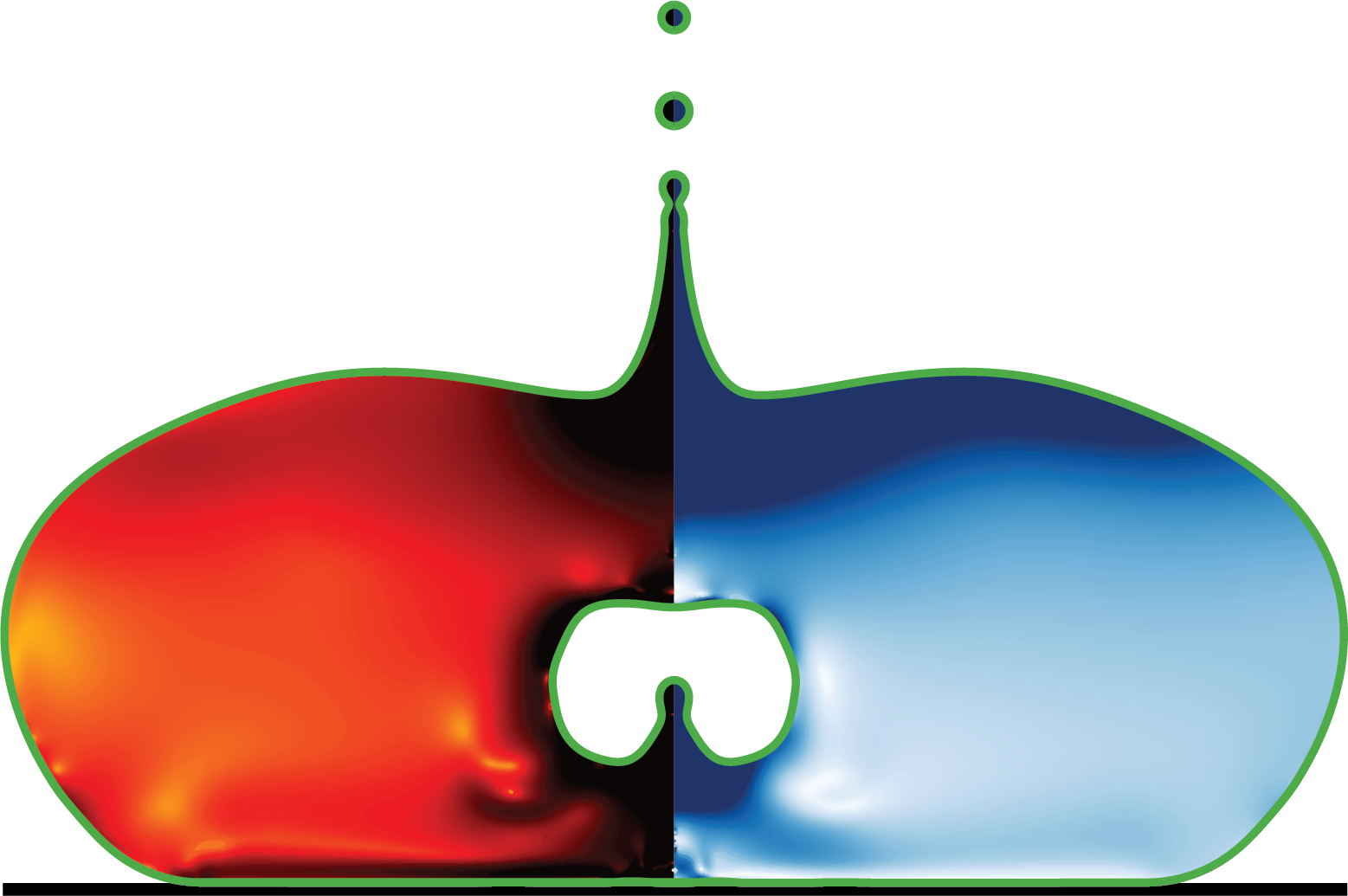
Bursting Bubble Simulations
Computational fluid dynamics simulations for bursting bubble studies using the Basilisk C framework.
Basilisk (Required)
First-time install (or reinstall):
curl -sL https://raw.githubusercontent.com/comphy-lab/basilisk-C/main/reset_install_basilisk-ref-locked.sh | bash -s -- --ref=v2026-01-13 --hardSubsequent runs (reuses existing
basilisk/ if same ref):
curl -sL https://raw.githubusercontent.com/comphy-lab/basilisk-C/main/reset_install_basilisk-ref-locked.sh | bash -s -- --ref=v2026-01-13Note: Replace
v2026-01-13with the latest release tag.
Overview
This repository contains axisymmetric two-phase flow simulations with adaptive mesh refinement for studying bubble bursting phenomena. The simulations use the Volume-of-Fluid (VOF) method to track the interface between the bubble and surrounding fluid, with automatic mesh refinement focused on regions of interest.
Quick Start
Single Simulation
# Edit parameters
vim default.params      # Set CaseNo, Oh, Bond, etc.

# Run simulation (serial)
./runSimulation.sh

# Run with MPI (4 cores)
./runSimulation.sh --mpi
Parameter Sweep
# Configure sweep
vim sweep.params        # Set CASE_START, CASE_END, sweep variables

# Run sweep (serial)
./runParameterSweep.sh

# Run sweep with MPI (4 cores per case)
./runParameterSweep.sh --mpi
Repository Structure
- src-local/
- Modular helper files
- parse_params.sh - Parameter parsing utilities (shell layer)
- sweep_utils.sh - Sweep generation utilities
- basilisk_version.sh - Centralized version pinning
- params.h - C-side runtime parameter layer (struct + file parser + CLI overrides + validation)
- postProcess/ -
Post-processing tools and visualization
- getData.c - Field extraction on structured grids
- getFacet.c - Interface geometry extraction
- Video.py - Frame-by-frame visualization pipeline
- simulationCases/ -
Case-based simulation outputs
- burstingBubble.c - Main simulation case
- DataFiles/ - Input geometry data
- runSimulation.sh - Single case runner
- runParameterSweep.sh - Parameter sweep runner (local)
- runSweepHamilton-serial.sbatch - HPC Stage 1 runner (Durham Hamilton)
- runSweepHamilton.sbatch - HPC sweep runner (Durham Hamilton)
- runSweepSnellius-serial.sbatch - HPC Stage 1 runner (SURF Snellius)
- runSweepSnellius.sbatch - HPC sweep runner (SURF Snellius)
- runPostProcess-Ncases.sh - Post-processing pipeline
- default.params - Single-case configuration
- sweep.params - Sweep configuration
Key Parameters
All knobs live in default.params (single
case) or per-case case.params files and are
read at runtime by the simulation; you never edit the
source to change a run. The main physical parameters
are:
- Ohnesorge Number (Oh):
Oh = mu/sqrt(rho*sigma*R)- ratio of viscous to inertial-capillary forces (OhRatiosets the gas-phase value,Oha = OhRatio*Oh) - Bond Number (Bo):
Bo = rho*g*R^2/sigma- ratio of gravitational to surface tension forces - tmax: Maximum simulation time (dimensionless, based on the capillary time scale)
- zWall: Distance from the bubble south pole to the bottom wall (sets the domain size)
Adaptive resolution
Both the mesh and the timestep are adaptive, and every control is a tunable parameter:
- Space —
MAXlevel(finest level, e.g. 12 = 4096 cells),MINlevel(far-field coarsening floor; the interface is always kept atMAXlevel),init_grid_level(initial uniform grid), and the wavelet error tolerancesfErr,VelErr,KErr. - Time —
CFL,TOLERANCE(Poisson/viscous solver), anddtmax.dtmaxis a ceiling, not a fixed step. Surface tension is time-explicit, sotension.hreduces the real step to the capillary-wave limitT = sqrt(rho_m * Delta_min^3 / (pi * sigma))every iteration. The effective timestep is therefore genuinely adaptive and scales with the finest cell size — coarser runs automatically take larger steps. (Earlier versions hard-cappeddtmaxat1e-5, below the capillary limit, which fixed the step and throttled the run.)
To change resolution, edit
default.params; to study its effect, sweep
it (e.g. SWEEP_MAXlevel=10,11,12 in
sweep.params). A legacy positional CLI
(./burstingBubble <MAXlevel> <Oh> <Bond> <tmax> <zWall>)
is still accepted as a fallback, but the parameter-file
interface is preferred.
Requirements
- Basilisk Framework: Install via the ref-locked script above (upstream docs: basilisk.fr)
- MPI (optional): For parallel
execution
- macOS:
brew install open-mpi - Linux:
sudo apt-get install libopenmpi-dev
- macOS:
Two-Stage Execution
The simulation uses a two-stage execution model due
to a Basilisk limitation (distance.h is
incompatible with MPI):
- Stage 1: Generate restart file (serial or OpenMP)
- Stage 2: Run full simulation from restart (supports MPI)
# Run both stages (default)
./runSimulation.sh default.params

# Or separately:
./runSimulation.sh --stage1 default.params    # Generate restart
./runSimulation.sh --stage2 --mpi 8 default.params  # Full simulation
Troubleshooting
“restart file not found”
Stage 2 requires a restart file from Stage 1. Run Stage 1 first:
./runSimulation.sh --stage1 default.params“restart file is empty”
Stage 1 may have failed silently. Check for: - Compilation errors in the case directory - Memory issues (reduce MAXlevel) - Invalid parameters
“qcc not found”
Basilisk is not installed. Run the install script:
curl -sL https://raw.githubusercontent.com/comphy-lab/basilisk-C/main/reset_install_basilisk-ref-locked.sh | bash -s -- --ref=v2026-01-13Parameters not updating on reruns
The scripts preserve existing
case.params and source files for reruns.
Use --force to overwrite:
./runSimulation.sh --force default.paramsHPC jobs failing
- Ensure Stage 1 completed locally before submitting Stage 2
- Check that restart files exist in each case directory
- Verify SLURM parameters match your allocation
License
Copyright (C) 2026 CoMPhy Lab.
This project is licensed under the GNU General Public License v3.0. See LICENSE for details.
Contact
For questions or collaboration inquiries, please contact the CoMPhy Lab.
Generated Documentation
Root Directory
- default.params
- runParameterSweep.sh
- runPostProcess-Ncases.sh
- runSimulation.sh
- runSweepHamilton-serial.sbatch
- runSweepHamilton.sbatch
- runSweepSnellius-serial.sbatch
- runSweepSnellius.sbatch
- sweep.params