simulationCases/burstingBubbleHB.c
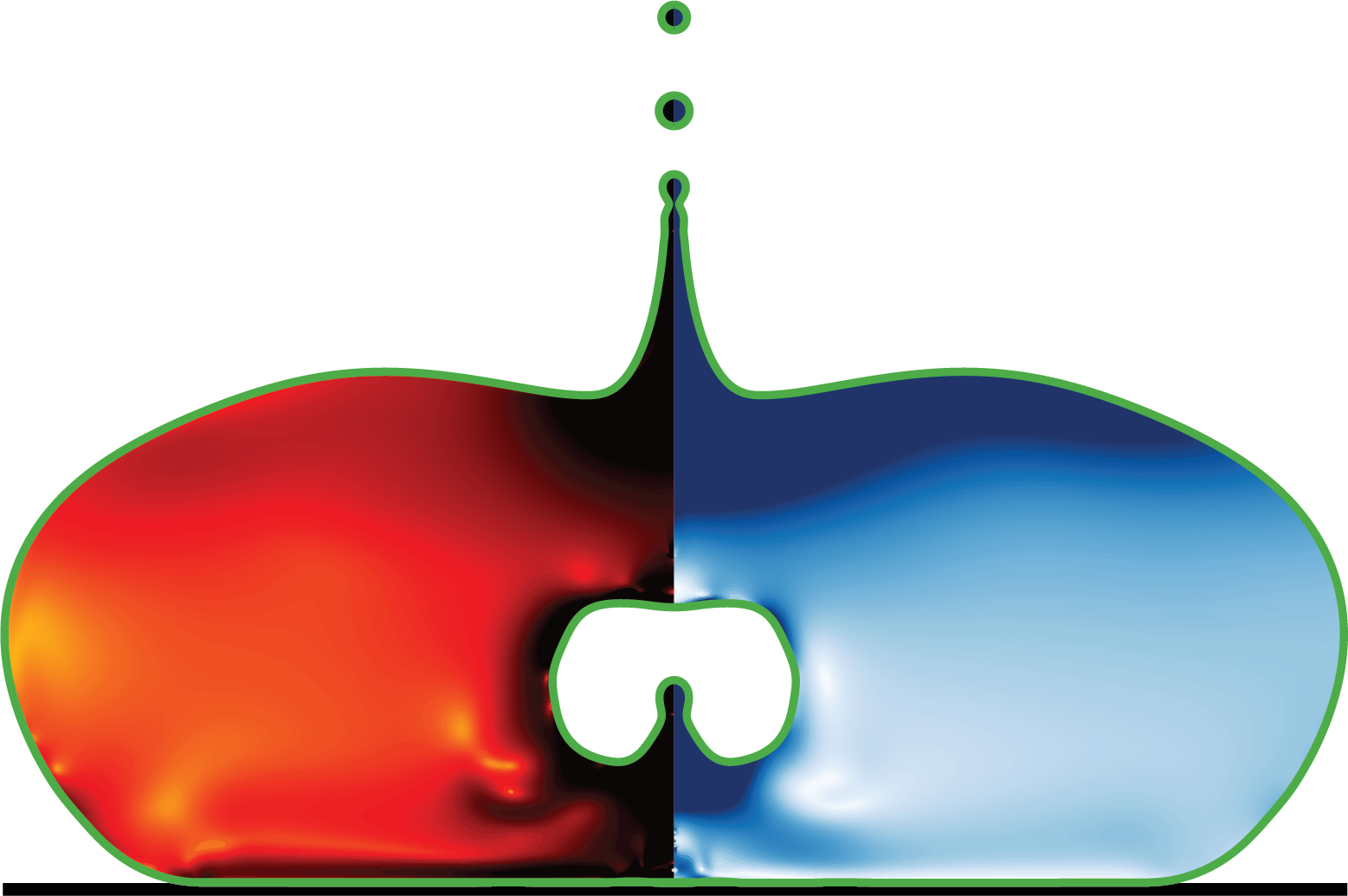
Bursting Bubbles in Herschel-Bulkley Media Simulation
This simulation models the dynamics of bursting bubbles in Herschel-Bulkley media, with particular focus on Worthington jet formation and droplet ejection. The code implements a two-phase flow model with non-Newtonian rheology using an epsilon-regularisation approach.
File Information
- File: burstingBubbleHB.c
- Author: Vatsal Sanjay
- Version: 1.0
- Date: Dec 31, 2024
Usage
./program maxLevel n OhK J Bond tmaxParameters
maxLevel: Maximum refinement level for adaptive meshn: Power-law indexOhK: k-effective Ohnesorge number for the liquid phase: \(Oh_k = \frac{k}{\sqrt{\rho^nR_0^{3n-1}\gamma^{2-n}}}\)J: Plasto-capillary number: \(\mathcal{J} = \frac{\tau_yR_0}{\gamma}\)Bond: Bond number (ratio of gravitational to surface tension forces): \(Bo = \frac{\rho g R_0^2}{\gamma}\)tmax: Maximum simulation time
#include "axi.h"
#include "navier-stokes/centered.h"
Simulation Configuration
Global Parameters
FILTERED: Enable density and viscosity jump smoothingtsnap: Time interval between snapshots (default: 1e-2)fErr: Error tolerance for volume fraction (1e-3)KErr: Error tolerance for curvature calculation (1e-6)VelErr: Error tolerance for velocity field (1e-3)D2Err: Error tolerance for conformation inside the liquid (1e-2)Ldomain: Domain size in characteristic lengths (8)
#define FILTERED // Smear density and viscosity jumps
#include "two-phaseVP-HB.h"
#include "navier-stokes/conserving.h"
#include "tension.h"
#include "reduced.h"
#if !_MPI
#include "distance.h"
#endif
#define tsnap (1e-2) // 0.001 only for some cases.
// Error tolerances
#define fErr (1e-3) // Error tolerance in f1 VOF
#define KErr (1e-6) // Error tolerance in VoF curvature calculated using
// height function method (see adapt event)
#define VelErr (1e-3) // Error tolerances in velocity -- Use 1e-2 for low Oh
// and 1e-3 to 5e-3 for high Oh/moderate to high J
#define D2Err (1e-2) // Error tolerances in conformation inside the liquid
// Domain size
#define Ldomain 8
66
// Boundary conditions - outflow on the right boundary
u.n[right] = neumann(0.);
p[right] = dirichlet(0.);
int MAXlevel;
double OhK, Oha, J, Bond, tmax;
char nameOut[80], dumpFile[80], logFile[80];Main Function
The entry point of the simulation that initializes parameters and starts the simulation run.
Parameters
argc: Number of command line argumentsargv: Array of command line argument strings
Returns
- Integer status code (0 on successful completion)
int main(int argc, char const *argv[]) {

  L0 = Ldomain;
  origin(-L0/2., 0.);
Parameter Initialization
Setting default values for simulation parameters. In production runs, these values can be passed from the command line.
  MAXlevel = 10;
  n = 0.4;
  OhK = 0.001;
  J = 2e-1;
  Bond = 1.1;
  G.x = -Bond;
  tmax = 2.5e0;
  epsilon = 1e-2;
Command Line Argument Parsing
To get parameters from the terminal, uncomment the following block.
// First ensure that all the variables were transferred properly from the
// terminal or job script.
if (argc < 7) {
  fprintf(ferr, "Lack of command line arguments. Check! Need %d more "
          "arguments\n", 7-argc);
  return 1;
}

MAXlevel = atoi(argv[1]);
n = atof(argv[2]);
OhK = atof(argv[3]);
J = atof(argv[4]);
Bond = atof(argv[5]);
tmax = atof(argv[6]);
epsilon = 1e-2; init_grid(1 << 5);
// Create a folder named intermediate where all the simulation snapshots are stored
char comm[80];
sprintf(comm, "mkdir -p intermediate");
system(comm);
// Name of the restart file. See writingFiles event
sprintf(dumpFile, "restart");
// Name of the log file. See logWriting event
sprintf(logFile, "logData.dat");Physical Properties Configuration
Phase Properties
rho1,rho2: Density of liquid and gas phasesmu1,mu2: Dynamic viscosity of liquid and gas phases
Dimensionless Numbers
Oh: Ohnesorge number for liquid phaseOha: Ohnesorge number for gas phase (= 2e-2 * Oh)J: Plasto-capillary numberBond: Bond number
  rho1 = 1., rho2 = 1e-3;
  Oha = 2e-2 * OhK;
  mu1 = OhK, mu2 = Oha;

  tauy = J;

  f.sigma = 1.0;

  TOLERANCE = 1e-4;
  CFL = 1e-1;

  run();
}
Initialization Event
Sets up the initial conditions for the simulation at t=0.
Process
- Attempts to restore from a dump file
- If not available, loads initial shape from data file
- Sets up distance function and volume fraction
event init(t = 0) {
#if _MPI // This is for supercomputers without OpenMP support
  if (!restore(file = dumpFile)) {
    fprintf(ferr, "Cannot restored from a dump file!\n");
  }
#else
  if (!restore(file = dumpFile)) {
    char filename[60];
    // sprintf(filename,"Bo%5.4f-buggy.dat",Bond);
    // sprintf(filename,"Bo%5.4f.dat",Bond);
    sprintf(filename, "Bo%5.4f-buggy_fixed.dat", Bond);
    FILE * fp = fopen(filename, "rb");
    if (fp == NULL) {
      fprintf(ferr, "There is no file named %s\n", filename);
      // Try in folder one level up
      // sprintf(filename,"../Bo%5.4f-buggy.dat",Bond);
      // sprintf(filename,"../Bo%5.4f.dat",Bond);
      sprintf(filename, "../Bo%5.4f-buggy_fixed.dat", Bond);
      fp = fopen(filename, "rb");
      if (fp == NULL) {
        fprintf(ferr, "There is no file named %s\n", filename);
        return 1;
      }
    }
    coord* InitialShape;
    InitialShape = input_xy(fp);
    fclose(fp);
    scalar d[];
    distance(d, InitialShape);

    while (adapt_wavelet((scalar *){f, d}, (double[]){1e-8, 1e-8}, MAXlevel).nf);

    // The distance function is defined at the center of each cell, we have
    // to calculate the value of this function at each vertex.
    vertex scalar phi[];
    foreach_vertex() {
      phi[] = -(d[] + d[-1] + d[0,-1] + d[-1,-1])/4.;
    }

    // We can now initialize the volume fraction of the domain.
    fractions(phi, f);
  }
  // return 1;
#endif
}
Adaptive Mesh Refinement
Implements wavelet-based adaptive mesh refinement to focus computational resources on areas of interest.
Refinement Criteria
- Volume fraction gradient
- Velocity field changes
- Conformation tensor variations
- Curvature details
event adapt(i++) {
  scalar KAPPA[];
  curvature(f, KAPPA);

  adapt_wavelet((scalar *){f, u.x, u.y, D2, KAPPA},
    (double[]){fErr, VelErr, VelErr, D2Err, KErr},
    MAXlevel, MAXlevel-6);
}
Output Generation
Periodically saves simulation state for post-processing and creates snapshots at regular intervals.
Output Files
- Restart file for continuing simulations
- Snapshot files for visualization and analysis
event writingFiles(t = 0; t += tsnap; t <= tmax) {
  dump(file = dumpFile);
  sprintf(nameOut, "intermediate/snapshot-%5.4f", t);
  dump(file = nameOut);
}
Simulation Termination
Executes when the simulation reaches its end time, displaying a summary of key simulation parameters.
event end(t = end) {
  if (pid() == 0)
    fprintf(ferr, "Level %d, n %2.1e, OhK %2.1e, Oha %2.1e, J %4.3f, "
            "Bo %4.3f\n", MAXlevel, n, OhK, Oha, J, Bond);
}
Simulation Monitoring
Tracks key metrics like kinetic energy during simulation and logs to file.
Features
- Calculates total kinetic energy
- Logs simulation progress
- Implements safety checks to stop simulation if instabilities occur
event logWriting(i++) {
  // if (i > 5){
  // FILE * ftest = fopen("test.txt", "w");
  // output_facets(f, ftest);
  // return 1;}

  double ke = 0.;
  foreach (reduction(+:ke)) {
    ke += (2*pi*y)*(0.5*rho(f[])*(sq(u.x[]) + sq(u.y[])))*sq(Delta);
  }
  if (pid() == 0) {
    static FILE * fp;
    if (i == 0) {
      fprintf(ferr, "Level %d, n %2.1e, OhK %2.1e, Oha %2.1e, J %4.3f, "
              "Bo %4.3f\n", MAXlevel, n, OhK, Oha, J, Bond);
      fprintf(ferr, "i dt t ke\n");
      fp = fopen(logFile, "w");
      fprintf(fp, "Level %d, n %2.1e, OhK %2.1e, Oha %2.1e, J %4.3f, "
              "Bo %4.3f\n", MAXlevel, n, OhK, Oha, J, Bond);
      fprintf(fp, "i dt t ke\n");
      fprintf(fp, "%d %g %g %g\n", i, dt, t, ke);
      fclose(fp);
    } else {
      fp = fopen(logFile, "a");
      fprintf(fp, "%d %g %g %g\n", i, dt, t, ke);
      fclose(fp);
    }
    fprintf(ferr, "%d %g %g %g\n", i, dt, t, ke);

    assert(ke > -1e-10);

    if (ke > 1e2 && i > 1e1) {
      if (pid() == 0) {
        fprintf(ferr, "The kinetic energy blew up. Stopping simulation\n");
        fp = fopen(logFile, "a");
        fprintf(fp, "The kinetic energy blew up. Stopping simulation\n");
        fclose(fp);
        dump(file = dumpFile);
        return 1;
      }
    }
    assert(ke < 1e2);

    if (ke < 1e-6 && i > 1e1) {
      if (pid() == 0) {
        fprintf(ferr, "Kinetic energy too small now! Stopping!\n");
        dump(file = dumpFile);
        fp = fopen(logFile, "a");
        fprintf(fp, "Kinetic energy too small now! Stopping!\n");
        fclose(fp);
        return 1;
      }
    }
  }
}