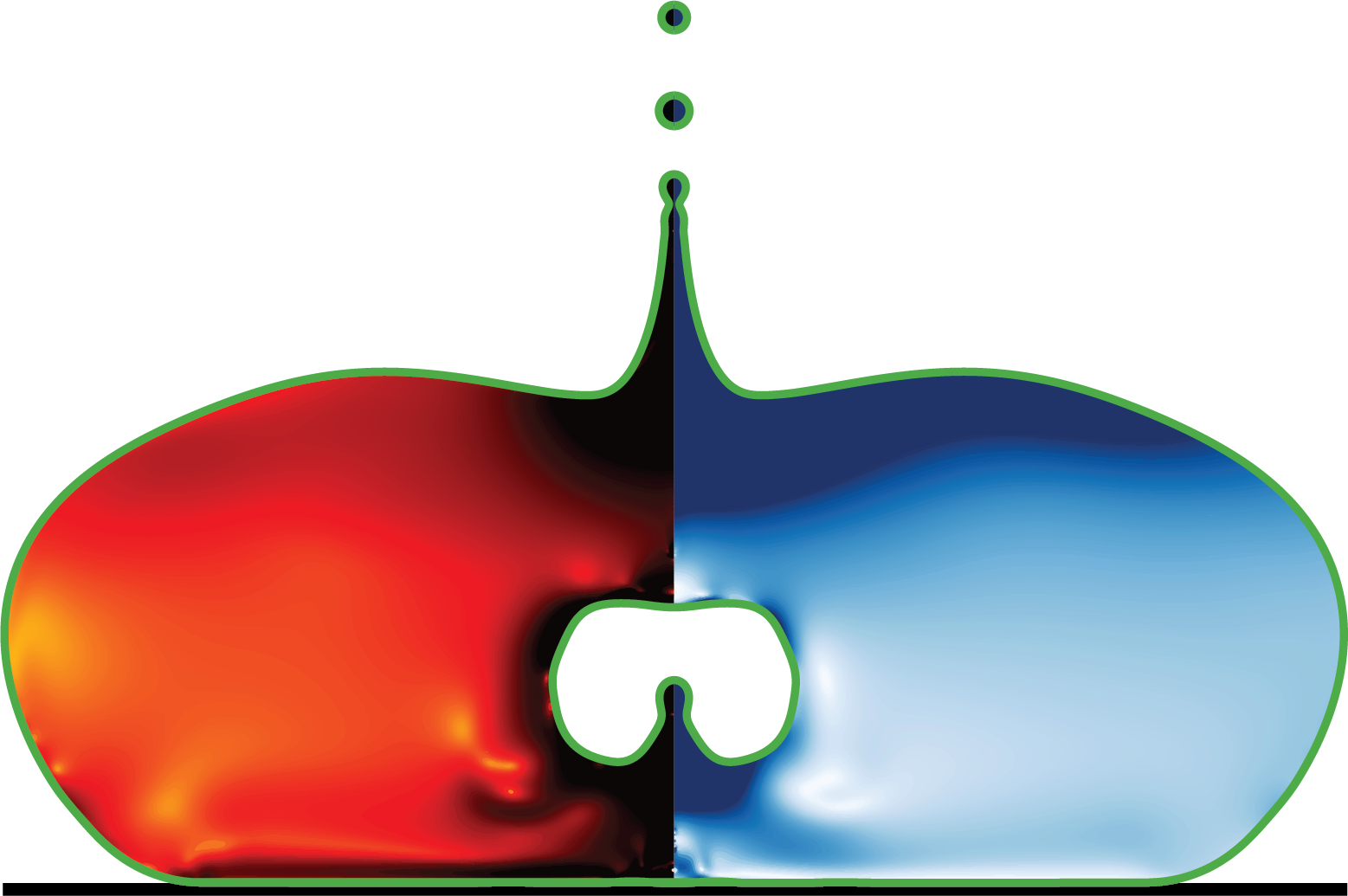
simulationCases/dropImpact.c
Drop Impact on Solid Surface
Axisymmetric simulation of a liquid drop impacting a solid surface using the Volume-of-Fluid (VOF) method with adaptive mesh refinement.
Physical Problem
A spherical drop of radius \(R\) impacts a solid surface with velocity \(U\). The simulation captures:
- Two-phase flow (liquid drop in surrounding gas)
- Surface tension effects at the liquid-gas interface
- Viscous dissipation in both phases
- Dynamic contact line motion
- Drop spreading and potential splashing
Coordinate System
Axisymmetric cylindrical coordinates: - \(x\): radial coordinate (distance from axis of symmetry) - \(y\): axial coordinate (height above surface) - Azimuthal symmetry assumed (no \(\theta\) dependence)
Governing Equations
Incompressible Navier-Stokes equations for two-phase flow:
\[\nabla \cdot \mathbf{u} = 0\]
\[\rho \left(\frac{\partial \mathbf{u}}{\partial t} + \mathbf{u} \cdot \nabla \mathbf{u}\right) = -\nabla p + \nabla \cdot (2\mu \mathbf{D}) + \sigma \kappa \mathbf{n} \delta_s\]
where: - \(\mathbf{u}\): velocity field - \(p\): pressure - \(\rho\), \(\mu\): density and viscosity (phase-dependent) - \(\mathbf{D}\): deformation tensor - \(\sigma\): surface tension coefficient - \(\kappa\): interface curvature - \(\mathbf{n}\): interface normal - \(\delta_s\): interface delta function
Dimensionless Numbers
Variables are normalized by drop radius \(R\), impact velocity \(U\), liquid density \(\rho_\ell\), and surface tension \(\sigma\):
- Weber number: \(We = \frac{\rho_\ell U^2 R}{\sigma}\) (inertia vs surface tension)
- Ohnesorge number: \(Oh = \frac{\mu}{\sqrt{\rho_\ell \sigma R}}\) (viscous vs surface tension)
- Reynolds number: \(Re = \frac{\rho_\ell U R}{\mu} = \frac{\sqrt{We}}{Oh}\) (inertia vs viscous)
- Bond number: \(Bo = \frac{\rho_\ell g R^2}{\sigma}\) (gravity vs surface tension, often negligible)
Numerical Method
- Spatial discretization: Adaptive quadtree grid (Basilisk framework)
- VOF method: Interface tracking using volume fraction field
- Projection method: Incompressibility constraint enforcement
- Adaptive refinement: Error-based mesh adaptation for interface and flow features
- Time integration: CFL-limited explicit time stepping
Usage
From parameter file:
qcc -I../src-local -O2 -Wall -disable-dimensions dropImpact.c -o dropImpact -lm
./dropImpact examples/default.params
From command line (legacy mode):
./dropImpact <MAXlevel> <tmax> <We> <Ohd> <Ohs> <Ldomain> [drop_x] [drop_y] [impact_vel]References
- Vatsal Sanjay ([email protected])
- CoMPhy Lab, Durham University
- Date: 2022-02-08 (original), 2025 (refactored)
See Also
- Basilisk: https://basilisk.fr
- Sanjay & Lohse (2025) - Unifying theory of scaling in drop impact
- Josserand & Thoroddsen (2016) - Drop impact review
- Yarin (2006) - Drop impact dynamics
// Basilisk includes
#include "axi.h"                           // Axisymmetric coordinates
#include "navier-stokes/centered.h"        // Centered NS solver
#define FILTERED// Filtered interface for stability
#include "two-phase.h"                     // Two-phase flow (VOF method)
#include "navier-stokes/conserving.h"     // Momentum conservation
#include "tension.h"                       // Surface tension forces

// Local modular headers
#include "params.h"                        // Parameter management
#include "geometry.h"                      // Geometry and initialization
#include "diagnostics.h"                   // Statistics and output
Compile-Time Constants
Basilisk’s event system requires compile-time constants for time intervals. These cannot be runtime variables from parameter files.
#define TSNAP (0.01) // Snapshot interval (fixed at compile time)Geometry Helper Macros
These must be defined here for Basilisk’s qcc preprocessor to see them.
#ifndef drop_distance_squared
#define drop_distance_squared(x, y, p) \
    ((x - (p)->drop_x) * (x - (p)->drop_x) + (y - (p)->drop_y) * (y - (p)->drop_y))
#endif
Global Configuration
All simulation parameters are stored in a single structure for: - Easy parameter passing - Clear organization - Extensibility
struct SimulationParams params;Boundary Conditions
Axisymmetric flow requires special treatment at axis and appropriate outflow conditions:
// Left boundary (axis of symmetry, x=0)
u.t[left] = dirichlet(0.0);   // No tangential velocity (azimuthal component)
f[left] = dirichlet(0.0);     // No fluid crosses axis (ensures symmetry)

// Right boundary (outflow, x=Ldomain)
u.n[right] = neumann(0.);     // Stress-free outflow (du/dn = 0)
p[right] = dirichlet(0.0);    // Zero reference pressure

// Top boundary (outflow, y=Ldomain)
u.n[top] = neumann(0.);       // Stress-free outflow
p[top] = dirichlet(0.0);      // Zero reference pressure

// Bottom boundary (y=0, solid surface)
// Uses default no-slip condition from centered solver
Main Function
Handles parameter parsing, validation, domain setup, and simulation launch.
int main(int argc, char const *argv[]) {Parameter Parsing
Supports two modes: 1. Parameter file:
./dropImpact config.params 2. Command line:
./dropImpact <MAXlevel> <tmax> <We> <Ohd> <Ohs> <Ldomain> ...
if (argc == 2 && access(argv[1], F_OK) == 0) {
// Parameter file mode
if (parse_params_from_file(argv[1], ¶ms) != 0) {
fprintf(stderr, "ERROR: Failed to parse parameter file\n");
return 1;
}
} else if (argc >= 7) {
// Command line mode (legacy compatibility)
if (parse_params_from_cli(argc, (char**)argv, ¶ms) != 0) {
return 1;
}
} else {
// Print usage and exit
fprintf(stderr, "Usage:\n");
fprintf(stderr, " %s <params_file>\n", argv[0]);
fprintf(stderr, " %s <MAXlevel> <tmax> <We> <Ohd> <Ohs> <Ldomain> [drop_x] [drop_y] [impact_vel]\n", argv[0]);
fprintf(stderr, "\nParameter file format: key=value (one per line)\n");
fprintf(stderr, "See examples/default.params for template\n");
return 1;
}Physics-Based Parameter Scaling
Convert tmax from convective time units to simulation time: tmax_sim = tmax * sqrt(We)
apply_physics_scaling(¶ms);Parameter Validation
Check physical constraints and consistency before starting simulation.
if (!validate_params(¶ms)) {
fprintf(stderr, "ERROR: Parameter validation failed. Exiting.\n");
return 1;
}Domain Setup
Initialize computational domain with specified size and initial grid.
    L0 = params.Ldomain;          // Domain size
    X0 = 0.;                       // Origin at axis
    Y0 = 0.;                       // Origin at surface
    init_grid(1 << params.init_grid_level);  // Initial grid: 2^init_grid_level
Material Properties
Set phase properties from dimensionless numbers: - Phase 1 (f=1): Drop (liquid, typically water) - Phase 2 (f=0): Surrounding (gas, typically air)
    rho1 = 1.0;                            // Drop density (normalized)
    mu1 = params.Ohd / sqrt(params.We);    // Drop viscosity from Oh and We
    rho2 = params.rho_ratio;               // Gas density
    mu2 = params.Ohs / sqrt(params.We);    // Gas viscosity
    f.sigma = 1.0 / params.We;             // Surface tension from We
Output Setup
Create output directory and open log files. File handles remain open for performance (avoids repeated open/close).
create_output_directory(params.output_dir);
open_log_files(¶ms);Print Configuration
Write complete parameter summary to stderr for verification.
print_params(¶ms, stderr);Launch Simulation
Start time-stepping loop (controlled by Basilisk event system).
    run();

    return 0;
}
Event: Initialization
Sets up initial conditions: drop shape, velocity field, and refined mesh.
Attempts to restore from restart file if available; otherwise initializes from scratch.
event init(t = 0) {
    char restart_path[512];
    snprintf(restart_path, sizeof(restart_path), "%s/restart", params.output_dir);

    if (!restore(file = restart_path)) {
        // No restart file found - initialize from scratch
        fprintf(stderr, "\nInitializing simulation from initial conditions...\n");
Grid Refinement
Refine grid around drop for accurate interface resolution. Uses 5% margin beyond drop radius.
const double refine_margin = 1.05;
const double refine_r_sq = refine_margin * refine_margin *
params.drop_radius * params.drop_radius;
refine(drop_distance_squared(x, y, ¶ms) < refine_r_sq &&
level < params.MAXlevel);
fprintf(stderr, "Initial grid refinement complete (MAXlevel = %d)\n", params.MAXlevel);Drop Initialization
Initialize VOF field and velocity field.
fraction(f, params.drop_radius * params.drop_radius -
drop_distance_squared(x, y, ¶ms));
foreach() {
u.x[] = params.impact_velocity * f[];
u.y[] = 0.0;
}
fprintf(stderr, "Initial drop setup complete:\n");
fprintf(stderr, " Drop center: (%g, %g)\n", params.drop_x, params.drop_y);
fprintf(stderr, " Drop radius: %g\n", params.drop_radius);
fprintf(stderr, " Impact velocity: %g\n", params.impact_velocity);
fprintf(stderr, "Initialization complete.\n\n");
} else {
fprintf(stderr, "\nSimulation restored from restart file.\n\n");
}
}Event: Adaptive Mesh Refinement
Dynamically adapts the mesh based on interface position and flow features.
Refinement criteria: - VOF field (interface tracking) - Curvature (surface tension resolution) - Velocity gradients (flow features)
Un-refinement near outflow boundaries prevents unnecessary resolution in far-field regions.
event adapt(i++) {Curvature Calculation
Interface curvature needed for surface tension and adaptation criterion.
    scalar KAPPA[];
    curvature(f, KAPPA);
Wavelet-based Adaptation
Adapt mesh based on multi-scale wavelet decomposition of fields.
    adapt_wavelet((scalar *){f, KAPPA, u.x, u.y},
                  (double[]){params.fErr, params.KErr, params.VelErr, params.VelErr},
                  params.MAXlevel,
                  params.MINlevel);
Outflow Region Un-refinement
Prevent spurious refinement near outflow boundaries where solution should be smooth (no drop, low velocities).
    unrefine(x > params.outflow_x_max ||
             y > params.outflow_y_max);
}
Event: Statistics Output
Calculates and logs flow statistics at regular intervals.
Avoids file I/O performance penalty by: - Keeping log file open throughout simulation - Writing buffered output - Flushing periodically
event statistics(i++) {
// Write statistics at specified interval
if (i % params.log_interval == 0) {
write_statistics(i, t, dt, ¶ms);
}
}Event: Snapshot Output
Saves complete simulation state for: - Restart capability - Post-processing and visualization - Long-term archival
Note: The time interval (TSNAP) must be a compile-time constant for Basilisk. The end time (params.tmax) can be a runtime variable.
event snapshots(t = 0; t += TSNAP; t <= params.tmax) {
save_snapshot(t, ¶ms);
}Event: Cleanup
Properly close all files at simulation end.
event cleanup(t = end) {
    close_log_files();
    fprintf(stderr, "\nSimulation completed successfully.\n");
}