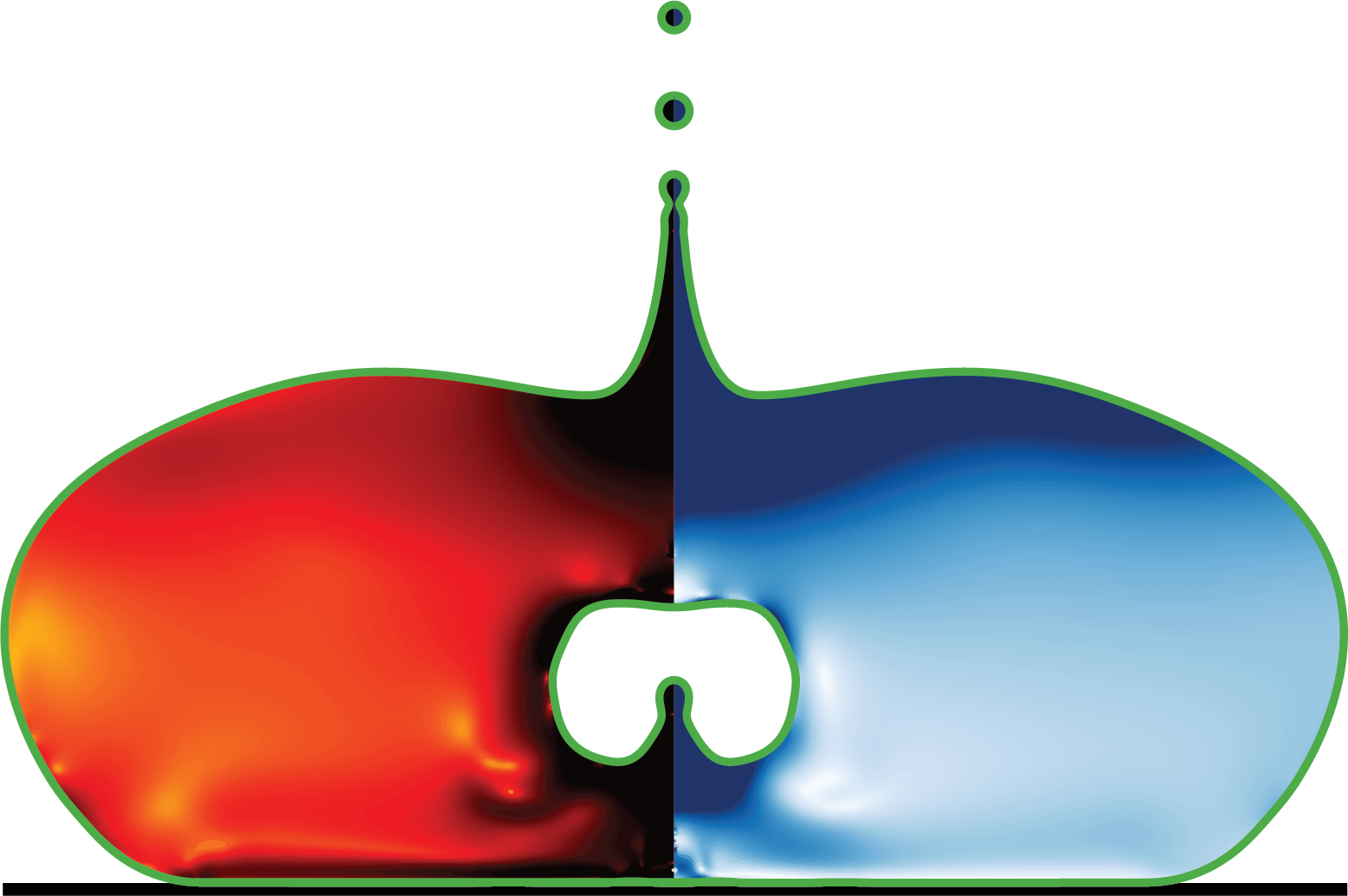
SOAPY - Simulation Of Axisymmetric Phenomena in bubblY films






Simulation Of Axisymmetric Phenomena in bubblY films
High-fidelity simulations of soap bubble dynamics and wrinkling instabilities using Basilisk C.
Research Overview
This repository contains computational tools for studying the dynamics of thin liquid films forming bubbles, with a focus on wrinkling instabilities driven by surface tension and viscous effects. The simulations solve the two-phase Navier-Stokes equations in axisymmetric configurations, capturing the complex interplay between:
- Surface tension-driven dynamics at the liquid-gas interface
- Viscous dissipation within the thin film
- Gravitational effects characterized by the Bond number
- Film thickness variations leading to instability formation
Physical System
The code models a soap bubble consisting of: - A thin liquid film (water with surfactants) - Surrounding gas phase (air) - Interface dynamics tracked using Volume-of-Fluid (VOF) method - Smoke tracer diffusion for flow visualization
Key Dimensionless Parameters
- Ohnesorge number (Oh): Ratio of viscous to inertio-capillary forces \[\text{Oh} = \frac{\mu}{\sqrt{\rho\sigma R}}\]
- Bond number (Bo): Ratio of gravitational to surface tension forces \[\text{Bo} = \frac{\rho g R^2}{\sigma}\]
- Péclet number (Pe): Ratio of advective to diffusive transport \[\text{Pe} = \frac{V_\gamma R}{D}\] where \(V_\gamma\) is the inertio-capillary velocity
- Curvature parameter (k): Ratio of bubble radius to film thickness \[k = \frac{R}{h}\]
Repository Structure
- basilisk/src/ - Core Basilisk CFD library (reference only, do not modify)
- simulationCases/ -
Test cases for simulation
- soapBubble-full.c - Full bubble simulation (spherical cap + rim)
- soapBubble-half.c - Half-bubble simulation variant
- postProcess/ -
Project-specific post-processing tools
- getData.c - Data extraction utility
- getFacet.c - Interface facet extraction
- Video-generic.py - Python script for post-processing
Simulation Configurations
Full
Bubble Simulation (soapBubble-full.c)
Models a complete bubble with: - Lower hemisphere: Circular cap geometry - Upper region: Spherical rim structure - Initial film thickness: \(h = 1/k\) - Adaptive mesh refinement near interfaces
Half
Bubble Simulation (soapBubble-half.c)
Variant configuration for studying partial bubble dynamics with modified boundary conditions.
Physical Parameters Used
| Parameter | Symbol | Typical Value | Description |
|---|---|---|---|
| Ohnesorge number | \(\text{Oh}\) | \(10^{-3}\) | Viscous effects |
| Density ratio | \(\rho_2/\rho_1\) | \(10^{-3}\) | Gas/liquid density |
| Viscosity ratio | \(\mu_2/\mu_1\) | \(10^{-3}\) | Gas/liquid viscosity |
| Curvature parameter | \(k\) | 25 | \(R/h\) ratio |
| Péclet number (gas) | \(\text{Pe}_{\text{gas}}\) | \(10^{-1}\) | Smoke diffusion |
| Domain size | \(L\) | 5.0 | Computational domain |
Installation and Usage
Prerequisites
- C99-compliant compiler (gcc or clang)
- GNU make
- Python 3+ with matplotlib, numpy for post-processing
Quick Setup
# Clone repository
git clone [email protected]:comphy-lab/soapy.git
cd soapy

# Install Basilisk locally
./reset_install_requirements.sh
source .project_config

# Compile simulations
cd simulationCases
make soapBubble-full.tst
Running Simulations
# Run full bubble simulation
./soapBubble-full.tst

# Run with custom parameters (edit source file for parameter changes)
# Key parameters: Oh1, k, tmax, MAXlevel

# Output files are saved in intermediate/ directory
Post-Processing
cd postProcess

# Compile data extraction tools
qcc -autolink getData.c -o getData -lm
qcc -autolink getFacet.c -o getFacet -lm

# Generate animations
python Video-generic.py --case ../simulationCases --folder output_frames
Output Data
The simulations generate: - Snapshot files: Binary dumps at regular intervals (\(\Delta t = 0.01\)) - Interface data: VOF field and curvature information - Velocity fields: Full velocity components in axisymmetric coordinates - Tracer concentration: Smoke diffusion patterns - Pressure fields: Dynamic pressure evolution
Scientific Background
The simulations investigate the Taylor-Culick instability in soap bubbles, where:
- Thin film dynamics: The bubble consists of a liquid film of thickness \(h \ll R\) (bubble radius)
- Wrinkling mechanism: Instabilities arise from the competition between surface tension and viscous forces
- Rim formation: The bubble edge develops a toroidal rim structure that influences stability
- Drainage patterns: Gravity and capillary forces create complex flow patterns within the film
Relevant Physics
- Taylor-Culick velocity: Characteristic retraction speed \[V_{\text{TC}} = \sqrt{\frac{2\sigma}{\rho h}}\]
- Rayleigh-Plateau instability: Drives rim breakup and droplet formation
- Marangoni effects: Surface tension gradients due to surfactant concentration
- Film thinning: Coupled drainage and evaporation processes
Numerical Methods
The code employs:
- Volume-of-Fluid (VOF) method for interface tracking
- Adaptive mesh refinement (AMR) for resolving thin films
- Implicit viscous solver for stability at low Oh numbers
- Conservative momentum advection for accurate interface dynamics
- Height-function curvature computation for surface tension
Contributing
This code is part of ongoing research. For collaborations or questions:
- Open an issue for bug reports or feature requests
- Contact the authors for research collaborations
- See CLAUDE.md for code style guidelines
Authors
- Saumili Jana - Primary developer ([email protected])
- Vatsal Sanjay - [email protected]
License
This project is licensed under the GNU General Public License v3.0 - see the LICENSE file for details.